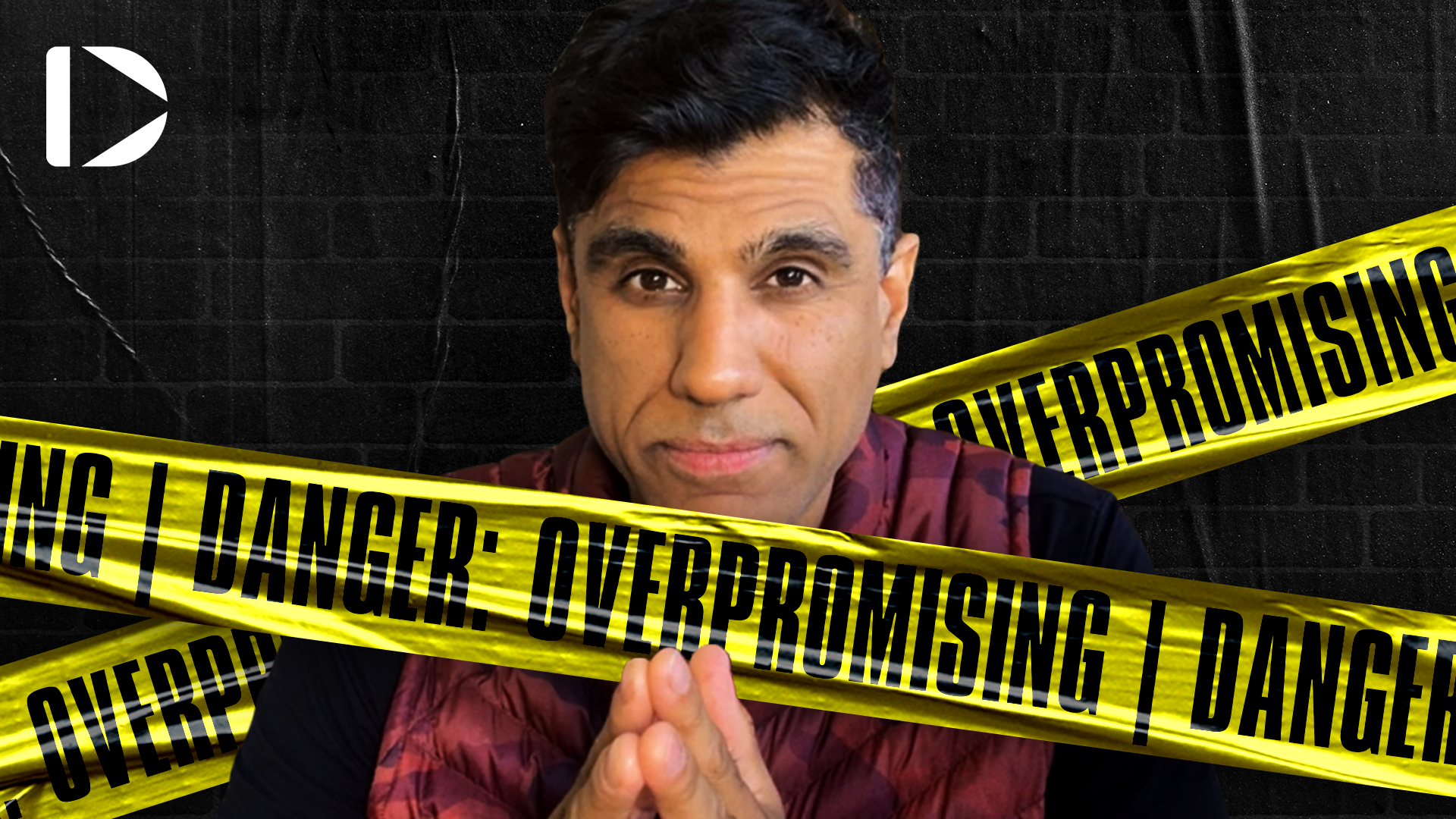
Overpromise: What It Means and How to Stop
To overpromise is to promise more than you can deliver. It is a commitment you cannot keep, made in the moment to win a deal, and it usually costs more than the deal was worth. This guide covers what the word means, why it happens under pressure, and the three question filter I now run before I commit to anything.
"I'll send it by end of day." Most of us have said it while knowing it was not true. It sounds helpful and committed. It is usually neither.
Overpromising is not generosity. It is a liability. Your word is your brand, and a missed deadline does not only cost a deal. It wears down the trust your clients place in you, and it wears down the person making the promise.
Here is why we do it, and the framework that stops it without turning you into the person who takes a week to answer an email.
What overpromising actually is
The dictionary definition is simple: to commit to more than you can reasonably deliver. The key word is reasonably. Not what you could deliver on your best day with nothing else on. What you can deliver given the week you are actually having.
"Overpromise and overdeliver" gets passed around as a motivational line. In practice, a team that always aims to go beyond what it committed to builds exhaustion, deadline creep, and clients who are never quite satisfied, because the baseline keeps moving.
Why you keep saying yes
It is rarely a calendar problem. It is a commitment problem, and it usually has the same root: saying yes is faster and more comfortable than saying "Thursday, and here is why."
"If I say no, I will disappoint them." That is the fear. The irony is that the fast yes is what ends up disappointing people, because a fast yes is usually a guess.
The cost, itemized
- The client is let down, and they remember the letdown more than the work
- You spend energy managing the thing you did not do instead of the thing you should be doing
- Your updates start to feel like apologies, so you send fewer of them
- The next deadline you give gets discounted, because your last one slipped
- You start avoiding the very people you were trying to impress
That last one is the expensive part. Deals rarely die from a delay. They die from silence after a delay.
The Reality Filter
Before you commit to a date, run three questions. It takes about thirty seconds and it saves the week.
- Reality. Based on your current workload and your actual delivery history, what is a realistic timeline? Not the fastest possible one. The one you would bet on.
- Friction. What else have you already promised? Does this date collide with anything you have not finished?
- Threats. What could derail this? A tool issue, a colleague's review, a client's late input, a school pick up. Name the most likely one out loud.
Then pad the answer, not to slack off, but to absorb the threat you just named. If the honest estimate is Wednesday, the commitment is Thursday at 10 a.m.
So instead of "end of day", say: "You will have this Thursday by 10 a.m." That is specific, it is checkable, and it is the kind of sentence that builds a reputation.
Overdelivering is overrated
Underpromising and overdelivering sounds clever, but it trains clients to expect more than you committed to, every single time. Then the day you deliver exactly what was agreed, it feels like a downgrade.
A better target: be precise, be realistic, be consistent. A person who hits the stated date every time is easier to recommend than a person who occasionally surprises you and occasionally disappears.
A worked example
A realtor I know used to answer every request with "you will have it by end of day". She meant it, and she was late most weeks, usually because a showing ran long. Clients noticed.
She started running the three questions before replying. Now her answer is "Tuesday by 9 a.m." It sounds slower. It almost never is, because she is no longer rebuilding trust every Friday afternoon. The change was not her workload. It was the sentence she used to describe it.
What to say instead
Swap the reflex answer for one of these. Each one keeps the relationship and keeps you honest.
| Instead of | Say |
|---|---|
| "I'll have it by end of day." | "You will have it Thursday by 10 a.m." |
| "No problem, I can add that." | "I can add that. It moves the launch to the 14th. Is that the right trade?" |
| "Just chasing this." | "Two of the three items are done. The third needs your approval on the copy." |
| "Sorry for the delay." | "This slipped a day because the file came in late. It is done now, and here it is." |
How to fix a promise you already broke
You will still miss something. What matters is the next message.
- Say it plainly, in the first line. No long setup.
- Give the new date, not an adjective. "Friday at noon" beats "very soon".
- Say what changed, in one sentence, without blaming a colleague.
- Send the part that is finished, if any of it is. Something delivered beats a promise delivered.
A short video is often the fastest way to do this. Thirty seconds, your face, the new date on screen, done. It reads as accountable rather than defensive, which is hard to pull off in text. If you want the format, see how to send video emails in business.
One thing to change this week
Pick the commitment you make most often, the one you say without thinking. For most people it is "end of day". From today, replace it with a specific day and time, and let the honest date do the selling.
Trust is slower to build than a deadline and much faster to lose. Say less, date it clearly, deliver it. That is how you build a business people believe in.
Say less, show more
Record a two minute video that walks the client through the real timeline, then let them watch on their own time before they reply.
Where overpromising hides besides deadlines
Deadlines are the obvious version. The expensive ones are the promises that never sound like promises at the time, because nobody writes them down and nobody remembers making them.
- Scope. "We can probably fold that in" turns into three weeks of unpaid work. If it is not in the statement of work, it was not agreed, no matter how warmly it was said on the call.
- Response time. "Just message me anytime" sets an expectation you cannot keep on your busiest week. Give the real window, even when it is unflattering.
- Features. "That is coming soon" is a roadmap promise made without a roadmap. Say what exists today and what you will tell them when it changes.
- Outcomes. "You will see results in a month" is a forecast dressed as a guarantee. Name the leading indicator you control and the two variables you do not.
- Hiring. The same instinct shows up in interviews, where managers promise growth, flexibility and headcount they have not secured. New hires remember every one of those sentences.
The test is simple. If the sentence would look different written in an email that the client's lawyer could read, it is a promise you should not make out loud. Saying it in a video message makes it worse, not better, because now there is a recording of it. If you send video regularly, the video CRM guide covers why that record is usually an advantage, and this is the case where it is not.
A language bank for committing in the moment
The reason people overpromise is not dishonesty. It is that the honest sentence does not arrive in time, so the optimistic one fills the silence. Keep these in your mouth instead.
| When they ask for | The overpromise | Say this instead |
|---|---|---|
| A delivery date today | "You will have it Thursday" | "I can have the first version Thursday and the final by Tuesday. Which one do you need first?" |
| A discount | "Let me see what I can do" | "I cannot move the price. I can move the start date, which protects your budget this quarter." |
| A feature that does not exist | "That is coming soon" | "It is not in the product today. Here is the workaround, and I will tell you the day that changes." |
| A guarantee of results | "You will double your replies" | "Teams in your setup usually see the first replies in week two. I will show you the number weekly." |
| Your attention | "Call me anytime" | "I answer within four hours on weekdays. If it is urgent, reply to the video and I will pick it up." |
Each of those answers gives the person something real to plan around. None of them says no outright, and every one of them is survivable in writing.
Run a commitment audit on your last thirty days
Most people discover they overpromise about four times more often than they thought. Thirty minutes with your sent folder tells you where the pattern lives.
- Open your sent messages from the last thirty days and search for "will", "by", "should be" and "soon".
- Copy every sentence that contains a commitment into one list. Do not edit them yet.
- Mark each one kept, late or missed. Late and missed are the ones that matter.
- For each missed item, write the sentence you should have sent. Almost always it starts with a number instead of a feeling.
- Keep the five hardest rewrites somewhere visible for a week. That is the whole exercise.
Repeat it quarterly. The list gets shorter every time, not because you get busier, but because you start hearing the overpromise before it leaves your mouth. If the pattern shows up most in follow up messages, the guide to personalized video messages shows how to keep a specific ask without inflating what you will deliver.
Frequently asked questions
Is overpromising the same as lying?
Not always. Most overpromising is optimism plus a deadline you did not check. The effect on trust is the same, which is why the fix is a habit, not an apology.
How do I say no to a client without losing them?
Do not say no to the request. Say no to the date, and offer the trade. "I can do that by the 21st, or I can do the smaller version by Friday. Which do you need?"
What if my manager sets the deadline?
Give the Reality Filter numbers back: what is realistic, what it collides with, what could break it. A manager can reject an opinion. It is harder to reject a specific risk you named in advance.
Does padding every deadline make me look slow?
Padding a promise you then hit looks reliable. Padding you then beat looks thoughtful. What looks slow is a date you set and missed.
How do I rebuild trust after a big miss?
One honest message, one new date, one early update before that date. Repeated on time delivery after a miss repairs more than any explanation.
Is underpromising a bad strategy?
Underpromising as a policy is just the mirror image of the same problem, because it trains people to discount what you say. Commit to the number you can hold, and say plainly that it is the number you expect to hit rather than the worst case you are hiding behind.
How do I hold a date when a client keeps pushing for an earlier one?
Give them the trade instead of a new date. A shorter timeline means a smaller scope, a paid expedite or a staged delivery. Placing the choice back with them turns a negotiation about your effort into a decision about their priorities.
Most of these habits come from the same place. The easy fixes for broken sales tactics covers the ones that cost you deals quietly.
Ready to see it for yourself? Start your free 7-day trial of Dubb and send your first video in the next five minutes.