Sales Prospecting 101: Replace Text with Video
This is the companion article to the video. The full transcript sits at the end, and the sections above it take the argument for asynchronous prospecting and turn it into a first message you can record today.
The first touch in forty five seconds
A prospecting video is not a demo. It is a reason to reply, and forty five seconds is enough for that.
Open with the specific thing you noticed: the page that is missing an answer, the job posting that suggests a change, the review that mentions a problem you solve. Then say what you do in one sentence, and what you would like them to do next, which is usually a short reply rather than a meeting.
The detail in the opening is the whole test. If the first sentence could have been sent to any company in the sector, the video is a template with a name on it, and the viewer can tell within three seconds.
Keep the production modest on purpose. A recording made at a desk, lit by a window, reads as a person sending a message. A produced piece with music reads as an advert, and adverts are what the buyer is already filtering out.
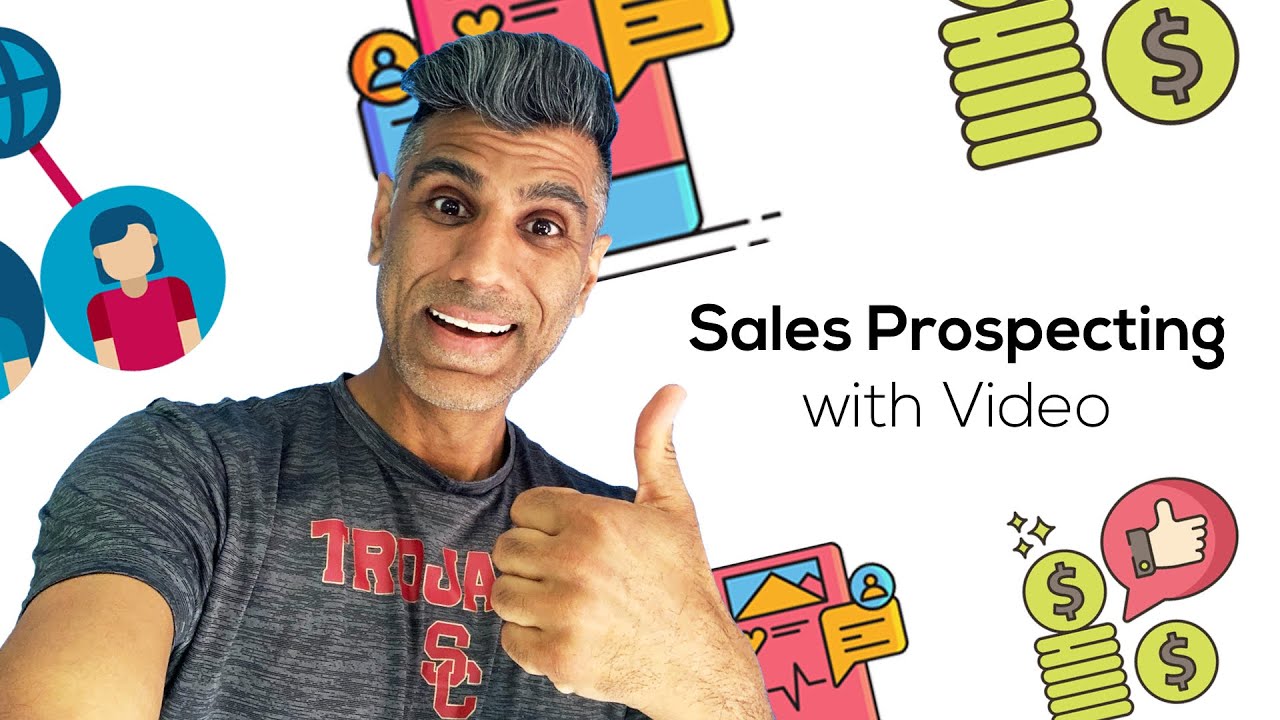
If the follow up is where your sequence stalls, sales prospecting with video covers prospecting with video end to end, cold email video and spam covers why video cold email lands in spam, and how to send a video email covers the mechanics of the send.
When video is the wrong format
Video is not always better, and using it on the wrong message wastes the advantage.
Skip it when the message is a single factual answer: a price, a date, a yes. A paragraph is faster for the reader and respects their time.
Skip it when the buyer has already asked not to receive video, which happens more than people admit, and skip it in a thread where six people are copied and the decision will be made in a meeting.
Use it when the message carries tone, or shows something on a screen, or needs to arrive as a person rather than a company. A short walkthrough of a proposal, an explanation of a change, an answer that would take four paragraphs: those are the cases where the format earns its place.
The test is whether watching it is faster than reading it. If the answer is no, write the email.
Turning a watch into a conversation
A video that gets watched and not answered has done half its job, and the missing half is usually in the closing line.
End with one question that is easy to answer in a sentence. Not let me know what you think, which asks the viewer to invent a reply, but would a fifteen minute call on Thursday be useful, or is this not a priority this quarter. Both answers are useful, which is the point.
Then watch the data before you follow up. If someone stopped halfway, the follow up can name the part they reached and answer the question that probably stopped them. If nobody opened it, send a different message rather than a reminder.
And reply in kind when the answer comes. A short video response to a question is faster to record than a careful email, and it signals that a person is on the other end of the sequence.
Doing it at volume without sounding automated
The tension in video prospecting is that the format only works when it feels individual, and individual does not scale by itself.
Resolve it by scaling the research rather than the recording. Ten well researched prospects with a forty five second video each will outperform two hundred template messages, and the difference is not effort per message, it is attention per prospect.
Then batch the mechanics: research in one block, recording in another, sending in a third. Batching protects the attention, because switching between finding a detail and delivering it is what makes both feel rushed.
Keep a list of what you noticed for each prospect, so the follow up can reference it. The recorded message is the first touch, the note is what makes the second one specific, and the two together are what a buyer experiences as being remembered.
Full transcript
So the most important thing I can say today about the current sales landscape is an evolution towards asynchronous prerecorded content being the absolute decider in the buyer's decision. So what I mean by that is, in the old days, with the old antiquated traditional cold call calls following up, chasing people down, all that nonsense, that's pretty much going the way of the dodo. We are so excited to talk to you today about the benefit method and the benefits of but before we get to that, the ultimate problem that most people in sales are suffering from is not making a connection. What I mean by that is not stirring up interest, not getting replies, and then ultimately not driving the sales that they want to. So an important question that you should ask yourself is, are you building trust? Are you creating relationships with the people that are in your prospect list? Because if you're not, chances are you're not going to achieve your sales goals. The problem here is what we like to call the hunt. And the problem with the hunt is that it's completely rooted in following up, but not in the positive way. Here's a short film that we made called the follow up that I think shows this idea in a really funny way, starring this guy. Oh, hey, Ali, how are you? Listen, I called you about 20 times earlier and I haven't heard back from you. Did you see our products that we do? They're really amazing. Are you just in buying? Oh, hey, so I'd recommend the latte back there is really good. By the way, did you get the 47 voicemails I just left you? I'm just really super excited to sell you this stuff. Oh, hey, Ally. How are you doing? What are the chances that you're in here? Listen, did you get one of my 47 voicemails I sent you? I haven't heard back from you yet. Hey, can we stop and get ice cream? Ice cream? Do you like ice cream? That's wrong. And I can't close the sale. I cannot close the sale. I don't know what's going on. It just sucks. Have you downloaded check it out in the app store? Dub. D-U-B-B. That's right, dub. And the key to remember here is when you're looking at a product or service, sometimes you get caught in the glow of the lights of the features and what it does, and all of that is important, but the features and the services are just the beginning point of illuminating what the benefits are to you as the buyer. That's what you've got to convey as a salesperson, not what the AC switch does in the car. It's what the eventual feeling of the AC does for the person in the vehicle and what that creates. That's what it's all about. So within the benefit method, it's all about the benefit to the end userbuyer in the car. It's not about the AC. Knob that you're turning in that feature. It's about what does that feature do to the person buying that vehicle? It keeps me cool on a warm summer day, right? And the heat keeps you warm on a cold winter day, if that's where you're located. But that's what it's about, remembering the big picture of what the benefits are to that buyer. So the benefit method is all about conveying the ultimate value to the person that's buying. It's about telling them how can they make money? It's about how can they save money, it's how can they increase their productivity and ultimately gain more happiness? Because at the end of the day, that is what we're all trying to buy. So gone are the days when we follow up, just to follow up. Now it's about providing additional value. And that is the benefit method. So here's a really interesting story that we can tell about this. A lot of people come to us because they simply did not use their CRM. And what's so interesting is what they tell us is that they never truly understood the benefits of the CRM that they were using. They only saw it as a micromanagement tool, never as a sales enablement tool. And it's always inspiring to us to show how the Dub sales operating system helps people record videos, create connections, and ultimately get conversions. And this is the classic benefits, not features. Benefits, not features. Benefits, not features. Thank you. And that is the benefit method. Let's talk about now the presentation. And what you have to be in today's environment is that you need to present like a Broadway show. I'll repeat that you need to present like a Broadway show. Here's my jazz hand. Right? There we go. A little song, little dance. But you want to have the ability to tell that story in an engaging, entertainment way. That's what people want. They want to hear a story that is just pulling them in. So think about that. And what we mean by a Broadway show for your sales effort is to provide so much delight, to tell stories that captivates people, and ultimately to get your customers to want to buy from you. Not because you're pushing them, but rather because you're pulling them in. One of our best examples on how to use video to delight is none other than Tesla. What Tesla does is that they build features that give massive benefits, but also that are just there to delight people. Like the karaoke function, the built in games, and even the Tesla that dances. Some of those videos garner millions and millions of views on YouTube. And they are solely there to delight us. And guess what? It sells. We are delighted. And what are they doing? They're putting on a show. The reality of the situation is that to use video to delight your prospects does not require any special technology at all. In fact, we've built an entire platform on such easy to use tech so that you and your sales team can start recording videos that convert. So the first thing you want to do to get things started is click on the button below sign up for dub. Once you do that, grab the Dub mobile app from the Play Store or the App Store, and you get the Gmail and LinkedIn integration. Get the Dub Chrome extension. So the first thing that you're going to want to do is to set up a simple call to action. This is a link to your website. It's a video reply. It's a form fill. It's a link to your calendar or anything else that you'd like to do. The second thing that you'll want to do is to record a video. This can be from your phone, from your webcam, or from your screen, if you have something visual that you want to show. Once you've recorded the video, the video landing page gets automatically created. Here is what the video landing page looks like. Now, think about that for a second. We recorded a video. We created a video landing page that has a direct call to action on it. This, my friends, is the ultimate sales conversion vehicle that is so easy to use. So one of my favorite features on the Dub platform is the video reply feature, which allows you to send a video to someone with a simple call to action so that they can respond to you with video. So by now, hopefully you understand the value of the benefit method, which is providing value and benefits to your prospects. The key here is using video. It doesn't stop at the videos that we create. We have to have videos of social proof. And what I mean by this is video testimonials case studies and demos of other people using your product or service. And one of the best calls to action that you can use is called the Reply with Video button. So, for instance, if you have someone out there that's bought your product or service, they want to put you over the moon in terms of their review about what you've done. All you do is say, please hit the Reply with Video button below, send me your testimonial back. And then as soon as they do that, you can add that to your case study page, which is easily built out for double. And the value of capturing a video like that is that you can build a new video landing page with that video, or you can add that video to a playlist so that when you send a personalized video to someone, the video that will follow is a testimonial video, and nothing will convert better than that. What Ruben just mentioned is monumentally important. When you make a video, the next video that plays in your playlist is one of the most powerful videos you can create, because that next video that's coming is going to be so special. And you can hint to that in the first video that you send. Check out this next video. Right? And another benefit of the dub platform is to be able to create a showcase page. And a showcase page is a number of videos that live on that page that ultimately help you get more conversions. So your sales Broadway show should answer three questions that your buyers have. So number one is what it does. Number two, how it works. Number three, why they need it, and number four, who else uses it? If your Broadway show can answer these four questions, you are going to see your conversions skyrocket, because that's what your buyers are thinking about. And that is the benefit method. Chances are, by now you've seen the power of video on the ecommerce sites that you're already using. For example, if you go to the Amazon homepage, you'll start to see live and prerecorded videos of influencers that are selling products. This is an example of how consumers need to see social proof. They need to see and feel what it would be like if they own that product. And that is what drives conversions. We invite you to get a free trial on Dub to see how you can empower your sales department to sell like Amazon. So, thank you for watching this episode of Rev Show. We invite you to grab a free trial to dub by clicking below. You can also check out the Dubout YouTube channel and subscribe there for more videos just like this one we'll see in the next episode. So, thank you for watching this video. If you got value out of this video, we encourage you to subscribe to the Rev Show Dubb's YouTube channel. Oh, the Rev Show. No, I'm looking here, but you're looking here. And the microphone is like this. I welcome to Lazy Eye Productions, where we're for Lazy Eyes, which talking like this, mass each other. And I said the rep shows.
Ready to see it for yourself? Start your free 7-day trial of Dubb and send your first video in the next five minutes.
Frequently asked questions
Does video prospecting actually get replies?
It gets replies when the opening names something specific about the recipient. A recorded template gets the same response as a written template, which is none.
How long should a prospecting video be?
Under sixty seconds, ideally around forty five. The reason to reply, one sentence on what you do, and one clear next step.
Should I use video for every prospect?
No. Use it where tone, a screen or a human face matters. For a single factual answer, a short email is faster and more respectful of the reader's time.
How many video messages can one person send a day?
As many as can be genuinely researched. For most reps that is ten to twenty, and the research is the limit rather than the recording.
Replace the paragraph with 60 seconds
The first touch gets a reply when it has a face, an offer and one clear next step.