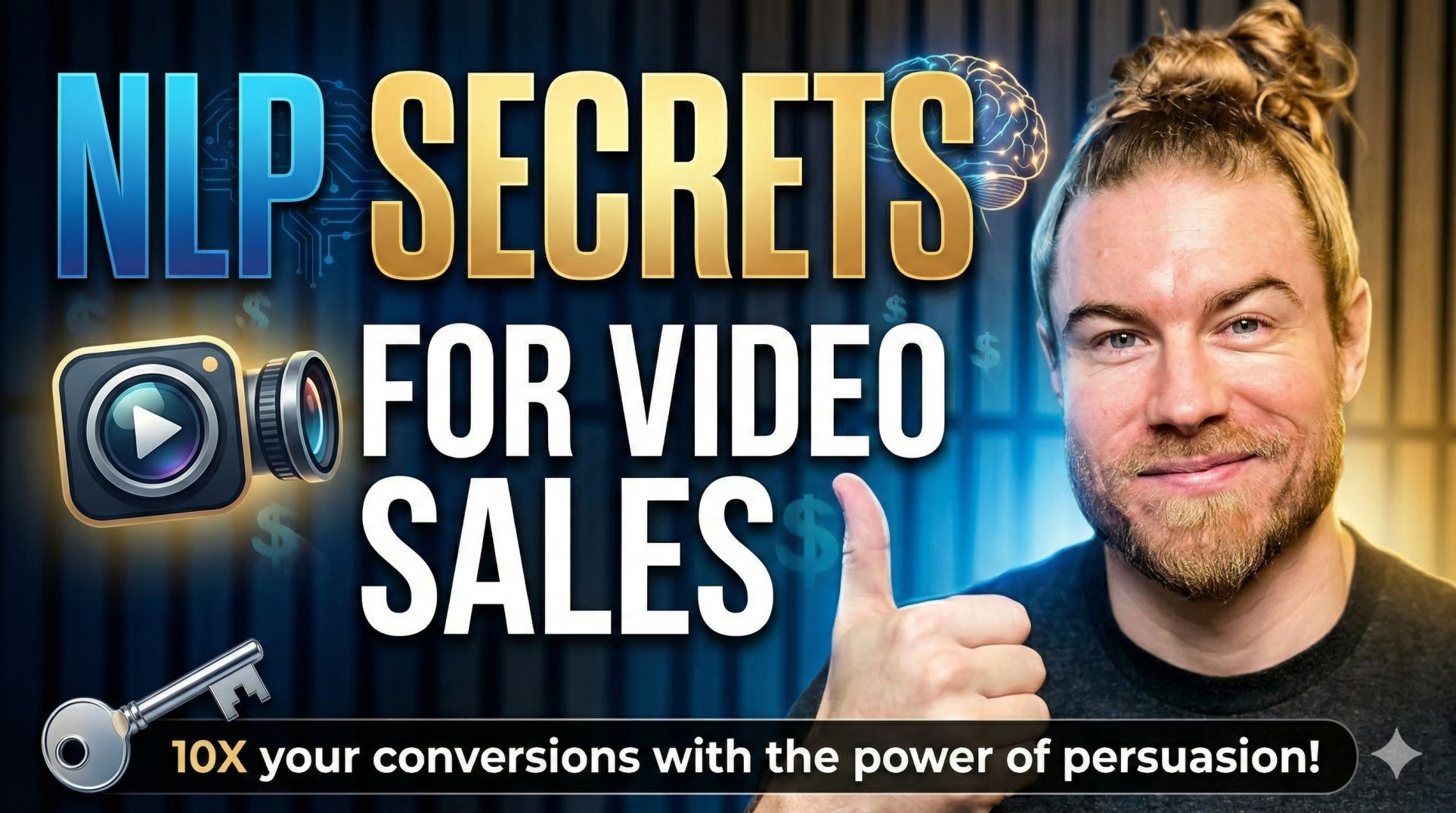
How do you use NLP training to write high converting video scripts?
NLP training can be applied to video scripts by selecting a small set of communication frameworks and using them to structure the hook, the message, and the next step. Drafts can be generated with an AI tool that supports natural language processing, then refined into speakable lines for recording. Results improve when scripts are sent, tracked, and iterated based on measurable response signals.What is NLP training?
NLP training is a communication skills training approach that teaches structured language patterns and messaging frameworks to improve clarity and decision-making in conversations. In business messaging, it is commonly used to make the outcome, next steps, and choices more explicit. In this workflow, the frameworks are applied to content created inside the Dubb platform, including video messages, social posts, and funnel content, then recorded using a voice-activated teleprompter and evaluated through send-and-measure iteration.Table of Contents
- Two meanings of NLP in modern workflows
- NLP frameworks for business video scripts
- How it works: AI generated scripts with NLP principles to teleprompter delivery
- Templates for high converting video scripts
- Using NLP in video messages without sounding scripted
- Common mistakes and troubleshooting
- Best practices for team rollout
- Dubb vs alternatives: choosing the right tool
- Proof: Why This Actually Works
- FAQ
Two meanings of NLP in modern workflows
“NLP” is often used to mean two different things: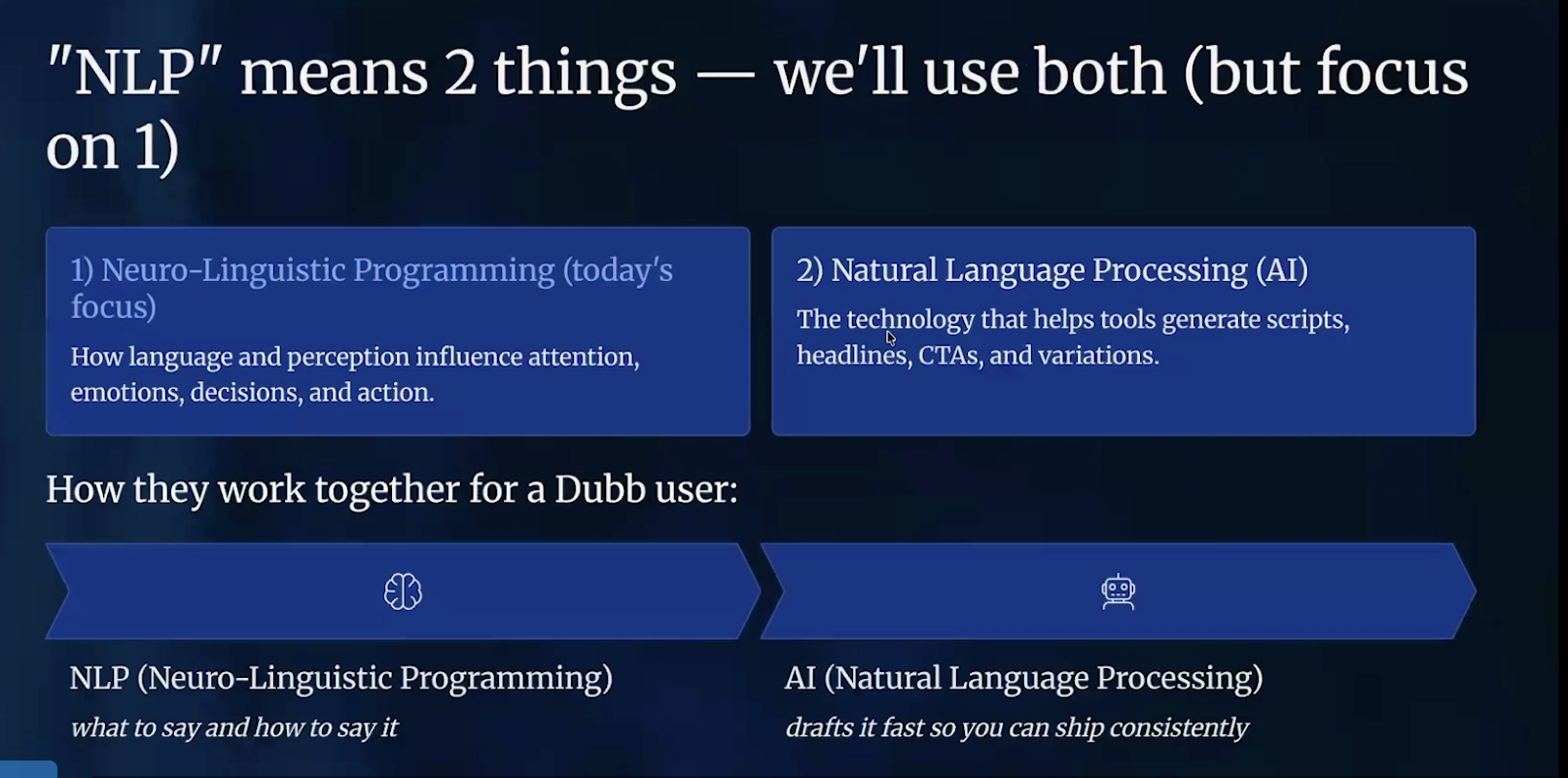
- Neuro-linguistic programming training: structured communication frameworks that improve clarity, authority, and ease of decision making.
- Natural language processing: the technology behind LLMs that can generate drafts and content, including scripts that incorporate those frameworks.
NLP frameworks for business video scripts
These frameworks are best treated as patterns that can be applied to many formats: video messages, social posts, funnel content, ads on Facebook, Instagram, and YouTube, and longer videos, including older video sales letter style formats.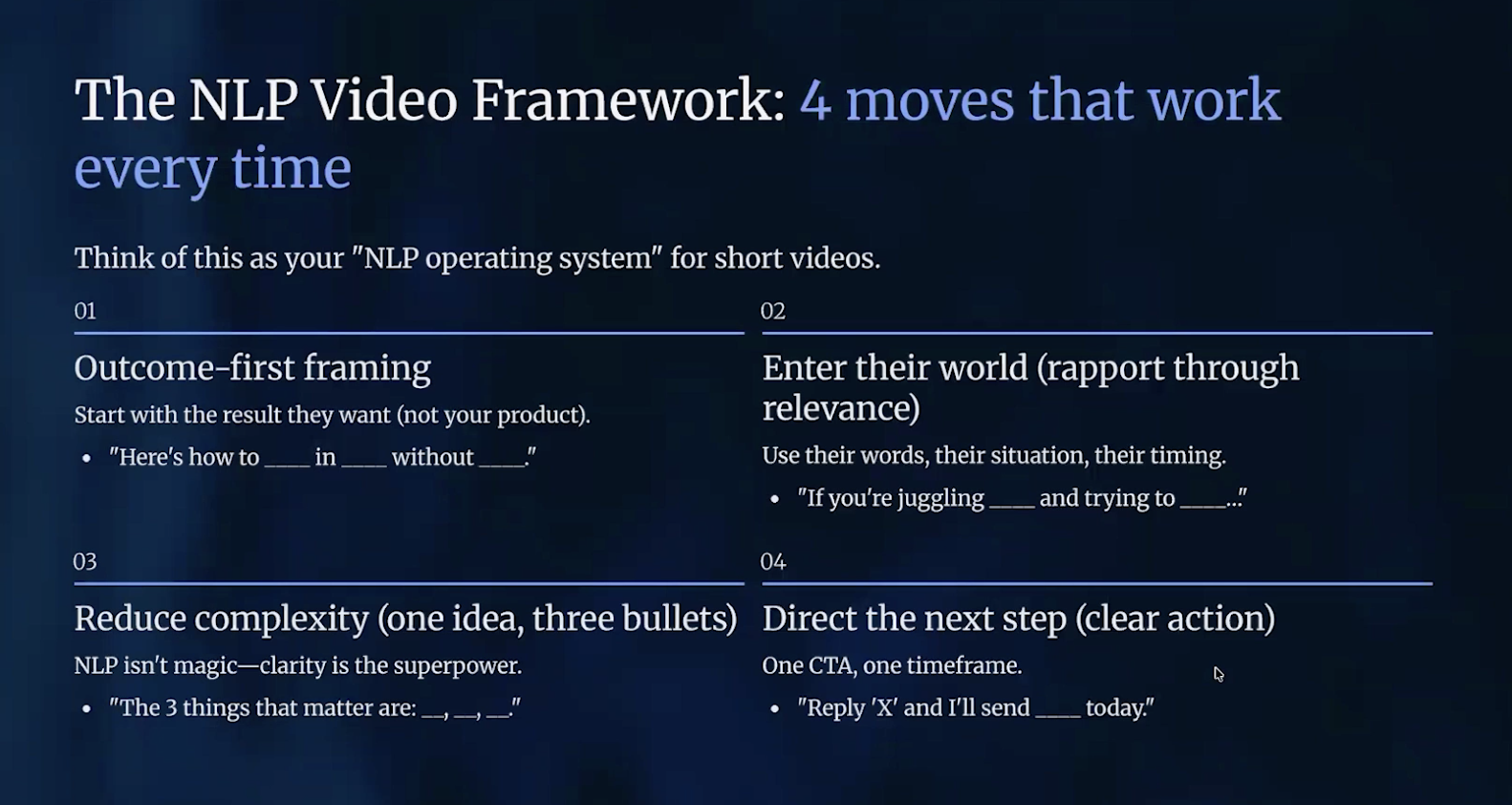
1) Outcome-first framing (hooks and titles)
Start with the result, then add constraints and a pain point. Pattern:- “Here’s how to [result] in [constraint] without [pain].”
2) Entering their world (using their words)
Lead with the viewer’s context so the message feels immediately relevant. Pattern:- “If you’re [their situation] and trying to [goal], this will help.”
3) Reducing complexity (three things that matter)
Turn a messy problem into a small number of priorities. Pattern:- “The three most important things are [1], [2], [3].”
4) CTA with a timeframe (clear next step)
A big part of the approach is clarity in the action. Pattern:- “Click the link below and let’s set up a time to talk this week.”
5) Pace leading and problem reframe
Accelerate the conversation by reframing the problem into a solution. Pattern:- “You could take hours doing this, but instead let me show you how to do it in [short time].”
- “It’s not that you’re bad on camera, it’s that you don’t have a structure producing the result you want.”
6) Future pacing (near-future outcome)
Make the outcome tangible by anchoring it to a near timeframe. Pattern:- “By this time next week, you could have [specific progress].”
7) Specific language over hype
The training emphasizes that clarity outperforms abstract claims. “Rocket ship your growth” is less effective than a concrete outcome tied to a timeframe and a mechanism.8) Choice close (reduce options)
Offer two options instead of an open-ended question. Pattern:- “What works best, Monday at 10 or Tuesday at 12?”
Related Dubb training lens: Authority, value, action
The training also references a prior framework, the “HAVE method,” as a similar idea: communicate authority, produce value, then ask for an action.How it works: AI generated scripts with NLP principles to teleprompter delivery
This step-by-step workflow is designed to go from framework selection to recording and measurement inside a single process.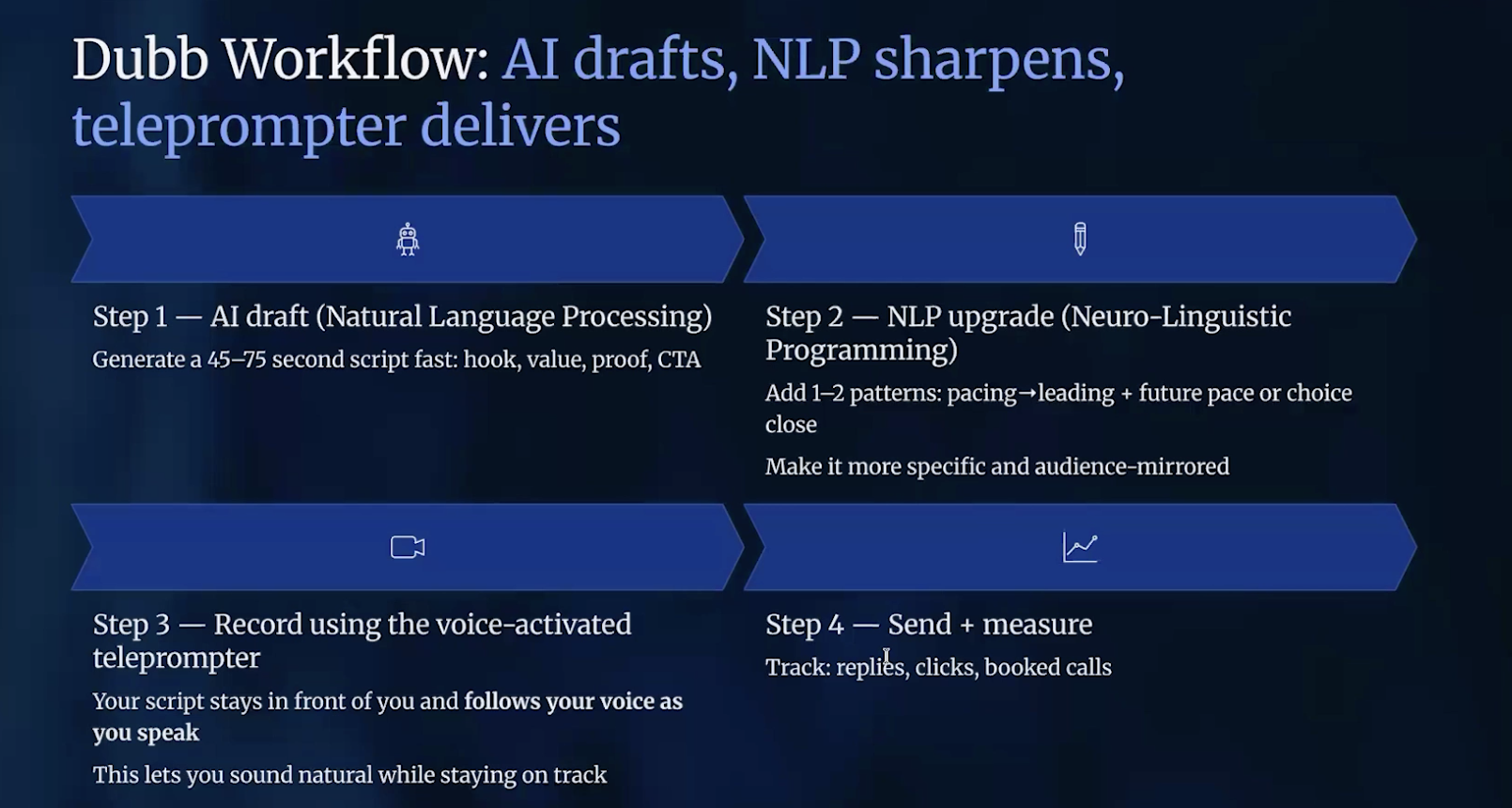
- Pick one framework (or combine a few). Common combinations include outcome-first framing plus a timeframe CTA, or reduced complexity plus a choice close.
- Generate the first draft with an AI tool. The workflow references using:
- Dubb Auto (as the in-platform option mentioned in the training)
- ChatGPT: https://chatgpt.com
- Gemini: https://gemini.google.com
- Add the draft to a teleprompter for recording. The workflow includes a one-click step to add the script into a voice-activated teleprompter, available on iPhone and Android. The teleprompter sits near the camera, supports pausing and natural inflection, and is positioned as an alternative to either memorizing the script or reading in a way that looks obvious.
- Send and measure. The workflow ends with sending the video, tracking performance, and using those signals to improve future automations and follow-ups.
Templates for high converting video scripts
These are short on purpose so they fit video messages, social content, email, and text message marketing.Template 1: Video message follow-up (outcome-first + reduced complexity + timeframe CTA)
Hook: “Here’s how to [result] in [timeframe] without [pain].” Body: “The three things that matter most are [1], [2], and [3].” Close: “Click the link below and let’s set up a time to talk this week.”Template 2: Nurture step (entering their world + problem reframe)
Open: “If you’re [their context] and trying to [goal], this is a common sticking point.” Reframe: “It’s usually not the tool, it’s the lack of structure.” Next step: “Reply with option 1 or option 2, and I’ll send the one you want.”Template 3: Short social video (pace leading + future pacing)
Open: “You could spend hours doing this, but here’s the fastest way to start.” Body: “Do [one step] and measure [one signal].” Future pace: “By this time next week, you could have [specific progress].” Operator insight: Keep one script focused on one outcome and one next step, because stacking multiple outcomes usually blurs what the viewer should do.Using NLP in video messages without sounding scripted
The workflow is designed to solve a specific problem: the speaker did not write the words, and may not feel like an expert in these patterns. The teleprompter is positioned as the bridge between a structured script and natural delivery. Practical ways to keep it conversational:- Edit drafts into short lines that match spoken rhythm.
- Keep the teleprompter close to the camera to avoid obvious eye movement.
- Use voice-activated pacing so pauses and emphasis feel natural.
Common mistakes and troubleshooting
Mistake: Treating frameworks like manipulation. The training frames this as improving communication so people can make decisions faster and with more clarity, not as negative manipulation. Mistake: Overusing abstract hype language. Scripts that stay vague make it harder to evaluate the offer. Specific outcomes and clear next steps tend to convert better than generic claims. Mistake: Too many choices at the close. A choice close reduces cognitive load. Open-ended “How can I help?” questions often slow decisions. Mistake: Reading AI output word-for-word. Most drafts need to be shortened for camera delivery. If it feels like reading, the script is usually too dense.Best practices for team rollout
- Standardize a small set of patterns. Pick 2 to 3 frameworks your team will use repeatedly, for example: outcome-first framing, reduced complexity, and choice close.
- Create prompts that encode the structure. Instead of “write a script,” use “write a script using future pacing and a choice close, ending with a timeframe CTA.”
- Use a consistent record-send-measure loop. The workflow emphasizes sending, tracking, and then using results to improve follow-ups and future automations.
- Train delivery, not just copy. Prepared structure can also improve camera presence by reducing uncertainty about what to say.
Dubb vs alternatives: choosing the right tool
Dubb is presented as a workflow that supports ideation-to-content creation across social posts, video messages, and funnel content, plus recording through a voice-activated teleprompter and a send-and-measure loop. It also references support via coaching and training, along with a free trial. For a fair landscape, common alternatives in the video messaging category include:- Loom: https://www.loom.com
- Vidyard: https://www.vidyard.com
- BombBomb: https://bombbomb.com
- ChatGPT: https://chatgpt.com
- Gemini: https://gemini.google.com
| Decision criteria | Best fit when | Tools to consider | Notes |
|---|---|---|---|
| Applying frameworks across video emails, automation, and nurturing | You need structured scripts to repeat across funnel steps and follow-ups | Dubb, Vidyard, BombBomb | Clarity patterns like timeframe CTA and choice close matter more than long explanations |
| Fast recording for explainers and internal sharing | You want quick capture and share, often outside a structured outreach flow | Loom | Script structure is still needed if the goal is response, not just view completion |
| Drafting scripts with natural language processing | You want rapid variations using explicit framework prompts | Dubb Auto, ChatGPT, Gemini | Drafts often need editing into speakable lines before recording |
| Short-form social and ads | Hooks, specificity, and next steps must land quickly | Dubb plus any distribution workflow | Outcome-first framing should stay realistic and specific |