


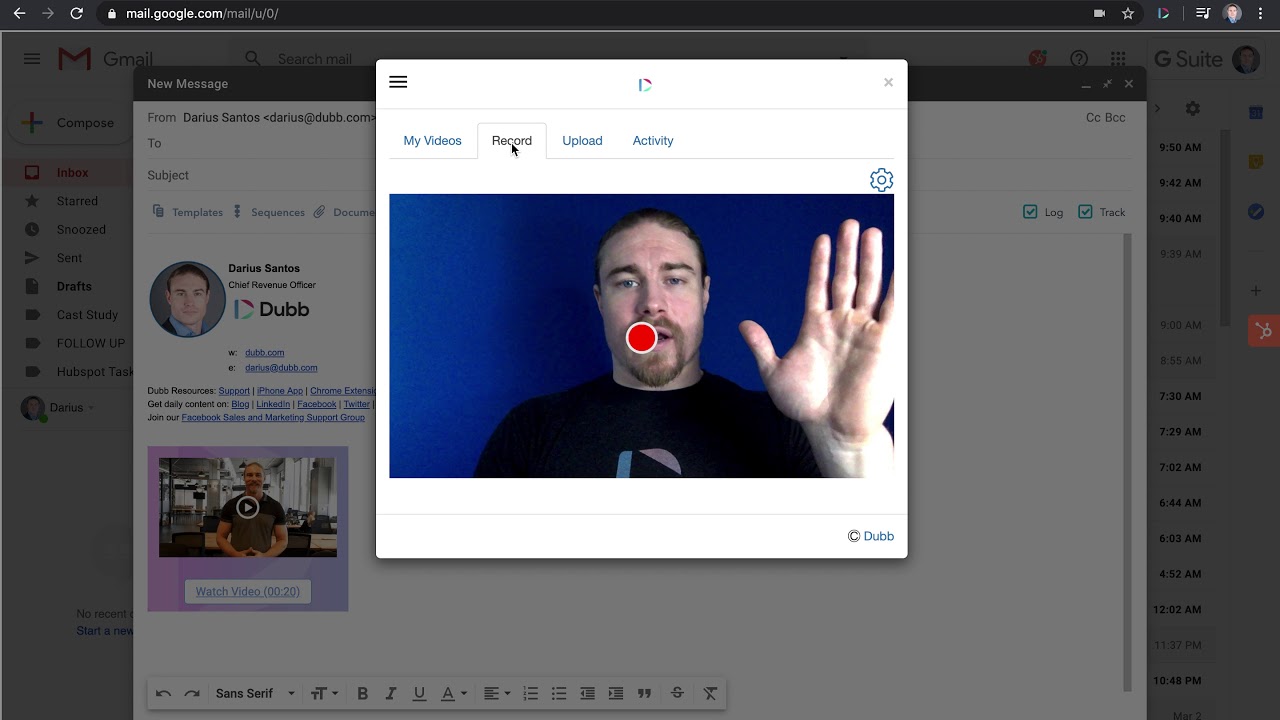
How to Record a Video in Dubb
Open Dubb, click record, and choose screen, camera or both. Turn the teleprompter on if you want a script, take the countdown, and start talking. When you stop, the video uploads and you can send it as a link, with the page, the call to action and the watch data already in place.
That is the whole loop. The rest of this guide is the detail that makes the first take usable: which of the four ways to record fits the moment, which settings are worth changing, what happens after you stop, and the mistakes that make a good message arrive as a bad video.
Four ways to record, and when to use each
None of these is better than the others. They are tools for different moments, and most people settle into two of them within a week.
| Route | Best for | Watch out for |
|---|---|---|
| Dubb website recorder | A webcam video from your desk, or uploading a file you already have | Grant camera and mic permission the first time |
| Chrome extension | Screen recording, a tab, or screen and camera together | Refresh the browser after installing |
| Mobile app | Anything shot away from a desk, and clips you want to splice | Steady the phone, and watch the light |
| Upload an existing file | A video made in another tool that still needs a page and tracking | Captions and a thumbnail still need setting |
Recording on the Dubb website
- Go to dubb.com, log in and open your dashboard.
- Click the plus button in the top right, which opens the video recording menu.
- Choose upload if the file already exists on your device, or camera to record a new one.
- Set video quality, microphone and camera on the preview screen. Grant camera and microphone permission if this is the first visit.
- Click the red record button. Use pause if you need a moment, and the red X to discard a take.
- Click the checkmark when you are done, and the video uploads to your library.
This is the route to use when you are at your desk and the message is the point. It is also the fastest way to get a file that already exists into a page with a call to action, because upload and record sit on the same screen.
Recording with the Chrome extension
Install the Dubb Chrome extension, which is free, then close and reopen the browser. A small Dubb icon appears in the toolbar.
Click the icon and you get the choices that matter for screen work: full screen, current tab, camera only, or an upload. Screen recording is the reason the extension exists. Pull up a contract and circle the clause that needs attention. Open the prospect's own website and talk through the three things you would change. Annotate a dashboard so the number you are talking about is the number they look at.
The same recorder is available inside the tools you already use. If you work in Gmail, the Dubb add-on records without leaving the compose window, and there are integrations for LinkedIn and for CRMs such as Salesforce. If you get an error saying your camera does not support the selected quality, uninstall the extension, clear the cache, reinstall, and grant camera and microphone permission again. The same fix applies to the Gmail and LinkedIn add-ons.
For a deeper walkthrough of the screen recording modes, the desktop screen recorder guide goes further, and recording screen and camera together covers the picture in picture setup.
Recording on the mobile app
Get the app for iOS or Android. The mobile app is the only one of the four that records in clips and lets you splice them together before uploading, which is useful for anything longer than a single thought.
Inside the app you can add text overlays, emojis and music, then send the finished video up to your Dubb library and attach a page with a call to action. Use it when you are on site, in a car before a meeting, or standing in front of the thing you want to show somebody. If you want the screen by screen walkthrough, the Dubb mobile app guide covers every control.
Settings worth changing before you hit record
Four settings decide whether the file is usable, and all four take seconds to check.
- Camera and microphone. If a laptop has two microphones, pick the right one before the take rather than discovering it in playback.
- Quality. Choose the highest your connection and device can hold. A camera that cannot support the setting will say so, and that message means change the setting, not buy a camera.
- Framing. Camera at eye level, face in the top third, background tidy rather than interesting.
- Length. Decide the target before you start. Thirty seconds for a reply, ninety for an offer, two minutes for a walkthrough.
Using the teleprompter
The teleprompter is the feature that changed how often I record. Memorising produces a stiff take and a fourth attempt. Reading produces a take you can send, and with practice it stops looking like reading.
Write for the ear, not the page. Short sentences, one idea each, and the name of the person in the first line. Set the scroll speed slightly slower than feels natural, because nerves speed you up. Using a teleprompter to record video covers the settings and the reading technique in more detail.
What happens after you stop
The upload finishes and you land on the video with its page. Four fields are worth filling in before you send it anywhere: a title a human would recognise, a description of one line, a thumbnail frame where your face is visible and your eyes are open, and the call to action button you want the viewer to press.
Then copy the link. That link is the whole point of the tool, because it plays in a browser, works on a phone, and reports what happened. If the video needs trimming or a caption fix, editing a video after you record it walks through the tools on the page itself rather than sending you to an editor.
Sending the video
Email is the default and the preview image does the work, because it plays inside the message in Gmail and Outlook. Text is faster and read sooner, and the link is the entire message. LinkedIn works when the video answers something public, and the link belongs in the first comment as often as in the post.
Whichever route you use, send it to one person at a time when the message is personal. A link in a group email is a broadcast, and a broadcast gets broadcast attention. Sending and tracking video messages covers how to follow up on the watch data.
Record the first one now
Camera, screen or both, with the teleprompter on the same screen. Free to start, no card needed.
Six mistakes in the first week
- Recording before deciding the first sentence. The opening line is the whole video; everything after it is explanation.
- Leaving the thumbnail on the default frame. A frame with your eyes closed costs you the click.
- Forgetting the call to action. The page is doing half the job without one.
- Shooting into a window. The camera exposes for the bright wall and you become a silhouette.
- One long take with no pause. Record in segments if the content is long, using pause or the mobile app's clip recorder.
- Never looking at the report. The follow up is where video earns its keep, not the recording.
What to record for five common jobs
The route and the length both follow the job. These are the five that come up most often, and the format that suits each.
| Job | Format | Where to record it |
|---|---|---|
| First touch to a prospect | 30 seconds, camera only, their name in the first line | Website recorder or extension |
| Walking through a proposal | 3 to 5 minutes, screen and camera together, annotated | Chrome extension |
| Answering a support question | 60 to 90 seconds, screen only, no intro | Chrome extension |
| A site visit or a walkthrough on location | 2 to 3 minutes, several clips joined | Mobile app |
| Onboarding or training | 2 to 4 minutes, screen, with a title that describes the task | Chrome extension or desktop |
A 60 second script you can fill in
Four sentences, in this order, is enough for almost any sales or marketing video. Write them in the teleprompter before you record, and read rather than recall.
- The reason for the video. Hi Sam, I saw you are hiring two account managers, which usually means onboarding is about to get heavy.
- The specific problem. Most teams at that point are recording the same walkthrough four times a week.
- What you do about it. We turn one recording into a page you can send, so the answer exists once and you can see who watched it.
- The single ask. If it is useful, book fifteen minutes with the link below and I will show you the two minute version.
Keep the whole thing under 150 words. If it runs longer, cut the third sentence rather than the first, because the reason for the video is what makes someone keep watching.
Recording screen videos people finish
Screen recordings fail for a reason that has nothing to do with the tool: they show too much. A browser with fourteen tabs, a mouse that wanders, and a narration that starts with let me just open this.
Three habits fix it. Close everything you are not showing, so the first frame has one window in it. Narrate the outcome before the clicks, which means saying what you are about to show and why it matters. And use the annotation tools to put a circle or an arrow on the one element you want the viewer to notice, because a cursor moving across a dashboard is not an explanation.
Record the shortest version that works, then send it. If somebody needs the long version, they will ask, and you will have saved twenty minutes and a viewer.
Light, sound and steadiness on a phone
Three checks before the first clip, and none of them need equipment. Light: stand so the light is on your face, not behind you, and turn off overhead lights that put a shadow under your eyes. Sound: get within a metre of the phone and record in the quietest space available, because phone microphones pick up air conditioning and traffic at a surprising distance. Steadiness: rest the phone on something solid, or brace your elbows on a surface, rather than holding it at arm's length.
Then turn on airplane mode. A notification in the middle of a take is the most common reason a good clip gets deleted.
What the report tells you the next day
The point of recording in Dubb rather than on a camera roll is that the send produces a report. The next day, look at three things: who opened it, how far they got, and whether they clicked the call to action.
Someone who watched to the end and did not click is a follow up, not a no. Someone who stopped at eight seconds tells you the opening line was wrong, and you can re-record for the next person. Someone who watched twice is worth a call. None of that is visible with an attachment, which is the practical argument for the link.
Re-record or fix it after?
Most first takes need one of the two, and choosing wrong wastes time. The rule I use is simple: if the problem is at the front or in the sound, re-record. If it is in the middle, fix it on the page.
| Problem | Fix |
|---|---|
| The first sentence rambles | Re-record. The opening decides whether the rest is watched |
| Background noise or a laptop fan | Re-record in another room. Noise cannot be edited out cleanly |
| A long pause or a repeated sentence in the middle | Trim it on the video page |
| A misspoken name or a wrong number | Re-record, and take the second version even if it feels less smooth |
Two takes is normal. Four is a signal that the script needs cutting rather than the performance improving.
What to do in the first week
Record five videos in five days, one per day, each to a real person. Day one is a reply to an open question. Day two is a short walkthrough of the thing you are asked about most. Day three is a first touch to a prospect who has gone quiet. Day four is a thank you after a call. Day five is a two minute training clip your team can reuse.
By the end of that week you will know which route you reach for, how long your takes actually need to be, and what your own watch data looks like. Nothing in this guide replaces that, and the setup takes minutes rather than a project.
Frequently asked questions
Do I need to install anything to record in Dubb?
No. The recorder on the Dubb website works in the browser. Install the Chrome extension if you want tab and screen recording, or the mobile app if you record away from a desk.
Why does my camera not show up?
Almost always a permission that was dismissed. Allow camera and microphone access for the site, then reload. For the extension and add-ons, uninstall, clear the cache, reinstall and grant permission again.
Can I pause partway through a recording?
Yes. Use pause on the recorder and continue when you are ready. On the mobile app you can also record in separate clips and join them before uploading.
Can I upload a video that was recorded somewhere else?
Yes. Upload it from the same recording menu, and it gets the same page, call to action and tracking as a video recorded in Dubb.
How long should a Dubb video be?
Thirty seconds for a reply, ninety for an offer, two minutes for a walkthrough, longer only when the viewer asked for the detail.
Can I record a screen video without showing my face?
Yes. Choose screen only in the extension, and the recording shows just the window or tab. Screen only suits support answers and internal training, where the viewer wants the steps rather than the person.
What if I need to send the same video to several people?
Send the same link, and the report still works because each viewer is listed separately. The message around the link is what needs to change per person, not the video, unless the content itself is personal.
Related reading: how to record personalized sales videos that convert, using a teleprompter, editing a video after you record it, and recording and sharing a case study video. More tools are listed at dubb.com/features, and you can reach the team through dubb.com/contact.
Send the video, watch what happens
Every video comes with its own page, a call to action and per viewer watch data. See who opened it within the hour.