


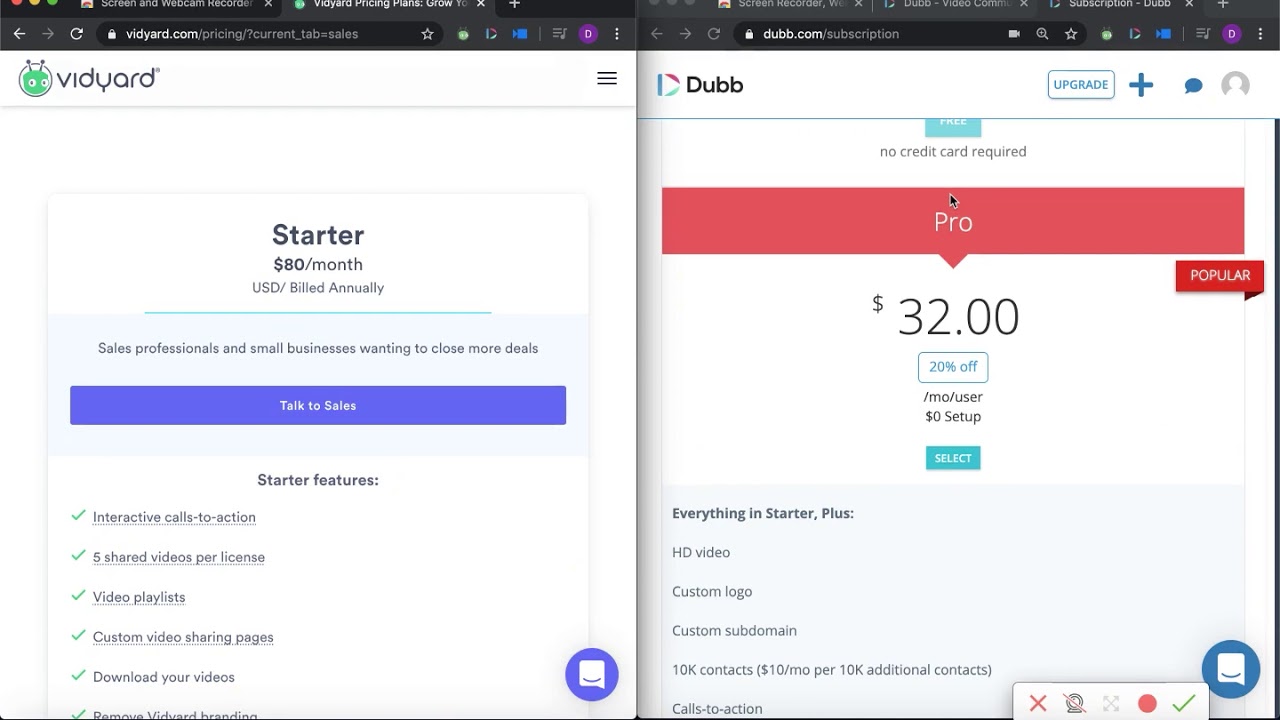
Vidyard Pricing 2026: What It Actually Costs per Seat
Vidyard publishes one price and quotes the other three plans. Starter is $59 per seat per month billed annually or $89 per seat month to month, with a 14 day trial and a 10 percent discount running at the time of writing. Free is $0. Teams and Enterprise are custom, and Teams is positioned for teams of five or more. There is also a separate Video Agent add-on at $24 per seat a month on annual billing or $29 monthly.
That is a simpler picture than most articles about Vidyard cost paint, because for years the honest answer was that almost nothing was published. Vidyard now states plainly that it uses per seat licensing with no overage fees, and that only Starter is bought with a card while Teams and Enterprise are invoiced.
This page prices each plan, works out what a team of one, five, ten and twenty five actually pays for a year, and sets the result against Dubb's per seat pricing. Every figure was read from Vidyard's and Dubb's own pricing pages on 18 November 2026. Prices exclude tax.
Every Vidyard plan, priced
| Plan | Annual | Monthly | Billing | Best for |
|---|---|---|---|---|
| Free | $0 | $0 | No card required | Testing video messages |
| Starter | $59 per seat | $89 per seat | Credit card | Individual sellers and small teams |
| Video Agent add-on | $24 per seat | $29 per seat | Added to a plan | AI generated video at volume |
| Teams | Quote | Quote | Invoice | Teams of five or more |
| Enterprise | Quote | Quote | Invoice, multi-year available | Security, SSO, secure playback |
Two details in that table decide most budgets. The first is that Vidyard prices per seat, so the cost scales with people rather than with video volume. The second is that the annual rate is roughly a third off the monthly rate on Starter, which means the monthly price is a penalty for flexibility rather than a real option for a team that already knows it will keep the tool.
What the free plan really gives you
Vidyard's free plan is more generous on AI than most free tiers in this category. It includes 15 AI videos, stock avatars, 3 custom AI avatars, video editing, video sharing and limited integrations. No card is required.
The limits are where the free plan stops being usable as a working tool: a limited number of videos per month, limited automated video creation and delivery, and limited integrations. There is no published storage figure, which matters if you plan to keep a library rather than send and forget.
A free plan with AI video included is unusual, and it is a legitimate reason to start on Vidyard rather than on a competitor that gates AI behind a paid tier. The trade is that the sending volume on Free is a demonstration allowance, so a rep trying to run a real week of prospecting will hit the cap.
What $59 a seat buys on Starter
Starter removes the video caps and adds the things a working seller needs: unlimited video recording, full video analytics, team performance analytics, a branded sharing page, CTA templates, password-protected videos, folder management and custom backgrounds.
At $59 a seat a month on annual billing that is $708 a seat a year. The figure to hold onto is that Vidyard's annual Starter price equals Dubb's monthly Pro price. On the same annual basis Dubb Pro is $42 a seat, which is $17 a seat cheaper a month, or $204 a seat a year.
What that $59 does not include is the CRM and marketing automation integrations, advanced team performance analytics, a fully customizable CTA and video captions. Those sit on Teams. For a sales team whose CRM is where the follow-up happens, that is the expensive line, because the plan that integrates costs a quote rather than a published price.
The Video Agent add-on
Video Agent is Vidyard's AI layer, priced separately at $24 a seat a month on annual billing or $29 monthly. It gives unlimited AI videos, keeps the 3 custom AI avatars from Free, and adds unlimited automated video creation and delivery. It is included in Enterprise.
Added to Starter, that makes the real per seat price for an AI first workflow $83 a month on annual billing, or $996 a seat a year. That is the number to compare, not $59, because a team buying Starter for the AI features will end up buying the add-on.
Whether the add-on is worth it depends on volume. Three custom avatars and unlimited generated videos is a production capability, not a sending one. If your team sends 200 personalised videos a month and half of them are AI generated, $24 a seat is cheap. If the AI output is a novelty that gets used twice, it is $288 a seat a year for something a free trial already showed you.
Worth noting for contrast: Dubb sells an AI Sales Agent at $50 a month with 50,000 credits, sold once rather than per seat, and it is aimed at answering and booking rather than producing avatar video. The two AI products do different jobs, so compare them on the job rather than on the price.
Why Teams and Enterprise are quotes
Teams is aimed at teams of five or more and adds the layer that makes Vidyard a system rather than a recorder: CRM and marketing automation integrations, advanced team performance analytics, an advanced branded sharing page, fully customizable CTAs and video captions. Enterprise adds unlimited integrations, SSO user management, secure playback, custom permissions and security options, and includes Video Agent.
Both are invoiced rather than bought with a card, and Vidyard offers annual and multi-year billing by invoice. That is standard for a vendor selling into mid-market and enterprise, and it has one practical consequence for a buyer: the price you pay depends on the deal rather than the page, so two companies of the same size can pay different rates.
Ask three questions on the quote. What is the seat count and what happens when it changes mid-term? Is the multi-year rate locked for the full term? And are captions metered or unlimited, since caption minutes are the most common quiet cap in this category.
One, five, ten and twenty five seats
Annual billing, before tax, Starter against Dubb Pro, both at published prices.
| Seats | Vidyard Starter | Vidyard Starter + Video Agent | Dubb Pro |
|---|---|---|---|
| 1 | $708 a year | $996 a year | $499 a year |
| 5 | $3,540 a year | $4,980 a year | $2,495 a year |
| 10 | $7,080 a year | $9,960 a year | $4,990 a year |
| 25 | $17,700 a year | $24,900 a year | $12,475 a year |
On published prices, Dubb Pro is cheaper at every seat count, including one. That is unusual in this category, where the account priced vendors usually win at the top and the seat priced ones win at the bottom.
The comparison that matters, though, is not Starter against Pro. It is Teams against Pro, because Teams is the plan with the CRM integrations a sales team needs, and Teams has no published price. If the Teams quote lands anywhere near $59 a seat, the two products are close enough that the decision should be made on workflow rather than cost.
Costs outside the seat price
- The add-on. Video Agent at $24 a seat a month is the first thing a team buys and the last thing it budgets for. Add it before comparing totals, not after.
- Seat creep. Per seat pricing means the bill moves whenever the team changes. A five seat plan with two departures is still a five seat invoice unless you ask for the seats back.
- Captions. Video captions sit on Teams, not Starter. A team that needs captions for accessibility is buying a quote, not a $59 seat.
- Launch services. Vidyard lists onboarding support across its plans, with guided onboarding and a dedicated success contact appearing on the higher tiers rather than on Starter.
Vidyard does state that its plans come without overage fees, which is worth taking at face value and confirming in writing. It removes the surprise invoice that storage or bandwidth metering usually creates, and it makes the seat count the only variable in the monthly number.
How to get a quote that means something
A quoted plan is only as useful as the questions you ask around it. Five of them turn a number into a budget.
Is the seat count named users or logins? A seat that can be reassigned when a rep leaves costs less over a year than one that cannot. Get the reassignment rule in writing, because it is the difference between paying for five sellers and paying for seven people, two of whom left.
What happens at renewal? Ask for the year two figure now, with the same seats. A first year discount that resets upward at renewal is common, and it is easier to plan for at signature than to argue about twelve months later.
What is metered? Captions, AI videos, storage and the number of integrations all appear somewhere in this category. Ask which of them are capped on the quoted tier and what an overage costs, even if the answer is that none are.
What does the quote assume about support? Guided onboarding and a named success contact are list items on higher tiers, and they are often the first thing removed in a discount negotiation. If you need them, price them separately rather than losing them quietly.
Finally, ask for the total in the same shape as the competitor you are comparing. If Vidyard quotes per seat per year and another vendor quotes a flat annual figure, convert both to cost per seat per year at your real team size before anyone looks at a slide.
What Dubb costs on the same job
Dubb Starter is free with 25 standard definition videos and basic pages. Pro is $59 a month or $42 a month billed annually, $499 per user per year, and includes unlimited HD video, email and SMS campaigns, 10,000 CRM contacts, 1 GB uploads, custom calls to action, landing pages, the teleprompter and the AI writing suite. Pro Plus is $129 a month or $90 annual, $1,080 a year, adding 4K, automation workflows, a custom domain and 50,000 contacts. Enterprise is a quote, and the AI Sales Agent is a separate $50 a month with 50,000 credits.
The structural difference is where the follow-up lives. Vidyard's integrations with the CRM and marketing automation platforms are the Teams tier, so the record of who watched lands in a system you already pay for. Dubb holds the contacts, the campaigns and the watch data in the same seat, which is cheaper to buy and narrower in scope, because it is not trying to be the system of record for a marketing department.
Where Vidyard sits in the market
Vidyard's $59 annual seat is the highest published entry price in the video email category. BombBomb is $36 a seat annual for Core and $56 for Pro. Hippo Video is $20 on Pro and $60 on Teams. OneMob is $49 monthly or $499 a year. Dubb is $42 annual. Only Wistia sits higher, at $79 a month for an account with three users, and Wistia is a hosting product rather than a sending one.
That position is defensible rather than expensive. Vidyard bundles AI video into the free plan and sells unlimited AI generation for $24 a seat, which is a lower AI entry price than most of the list above. A team whose main reason for buying is AI generated video will find Vidyard cheaper than a stack of a recorder plus a separate generator.
For the rest of the category, what Wistia costs covers the hosting model, the BombBomb cost comparison covers the closest competitor on workflow, and how to choose the best video marketing platform sets out the questions that separate them.
Which plan fits which team
Stay on Free if you want to test AI video generation without a card. Fifteen AI videos and three custom avatars is more than any other free tier here, and it is enough to decide whether the output fits your brand.
Buy Starter if you are one or two sellers who need unlimited recording, analytics and a branded sharing page, and your CRM integration needs are already met by a browser extension. At $59 a seat annual it is the most expensive entry seat here, and it needs no quote to buy.
Add Video Agent if AI generated video is a weekly habit rather than a test. At $24 a seat it is cheaper than most standalone generators, and it is included in Enterprise if you are heading there anyway.
Ask for a Teams quote if your CRM is where follow-up happens, or if you need captions. Get the seat count and the caption allowance in writing, because that quote is the number your budget actually depends on.
For the product side rather than the price side, the Vidyard guide covers what the platform does, and Vidyard alternatives covers who else solves the same problem.
Frequently asked questions
How much does Vidyard cost?
Free is $0, Starter is $59 per seat per month billed annually or $89 month to month, the Video Agent add-on is $24 a seat on annual or $29 monthly, and Teams and Enterprise are quoted. Prices were read from Vidyard's pricing page on 18 November 2026.
Does Vidyard have a free plan?
Yes. It includes 15 AI videos, stock avatars, 3 custom AI avatars, video editing and sharing, with limits on videos per month and integrations. No card is required.
Is Vidyard priced per user?
Yes. Vidyard describes its model as per seat licensing, so the cost scales with the number of people rather than with storage or video volume, and it states that its plans carry no overage fees.
Why is Teams not priced on the website?
Teams and Enterprise are invoiced rather than bought with a card, and Vidyard quotes them per deal. Teams is positioned for teams of five or more and adds CRM and marketing automation integrations, advanced analytics, captions and customizable CTAs.
Is Vidyard cheaper than Dubb?
On published prices, no. Vidyard Starter is $59 a seat a month billed annually against $42 for Dubb Pro, so a five seat team pays $3,540 a year against $2,495. Teams, which is the tier with CRM integrations, is a quote.
Is there a free trial?
Yes. Starter comes with a 14 day trial, and the free plan itself requires no credit card.
Price the alternative on a real video
Dubb Starter is free and needs no card. Record a video, send it, and see who watched before you commit to a per seat plan.
Conclusion
Vidyard costs $59 a seat a month on annual billing for Starter, or $89 month to month, with a free plan that includes AI video and a $24 add-on for unlimited generation. Teams and Enterprise are quotes, and Teams is the one your sales team will need if the CRM is where the follow-up lives.
On published prices, Dubb Pro at $42 a seat is cheaper at every size and puts campaigns, contacts and calls to action in the same seat. On AI, Vidyard is the better value, with generation in the free plan and an add-on that costs less than most standalone generators. Which of those two facts matters more is a question about your team, not about either price list.