How Do You Send Video in Mailchimp?
Mailchimp does not support native HTML5 video embeds in email campaigns. The standard workaround is to host your video externally, create a clickable thumbnail or animated GIF inside the Mailchimp editor, and link that image directly to your video URL. The result looks like an embedded video to recipients but routes them to a hosted playback page where autoplay, audio, and full engagement tracking all work reliably.
What Is Video Email Marketing?
Video email marketing is a distribution strategy in which marketers include video content or links that lead to video content inside email campaigns to increase engagement, convey complex messages, and drive click-throughs.
Because most major email clients, including Gmail and Outlook, do not render HTML5 <video> tags, the standard implementation uses a static or animated image as a stand-in. That image is hyperlinked to an externally hosted video page. When a recipient clicks the image, they land on a page where the video plays natively.
Tools like Dubb are built specifically for this workflow. Dubb provides a Chrome Extension that lets users record, select, or upload a video, generate a shareable video URL, and insert a thumbnail link directly into email platforms like Mailchimp.
Table of Contents
- What Is Video Email Marketing?
- Why You Can’t Directly Embed Video in Mailchimp
- How to Send Video in Mailchimp: Step-by-Step
- Choosing the Right Thumbnail: Static Image vs. Animated GIF
- Video-in-Email Tool Comparison
- Best Practices for Video in Email Campaigns
- Common Mistakes and How to Fix Them
- Proof: Why This Actually Works
- FAQ
- Sources and Further Reading
Why You Can’t Directly Embed Video in Mailchimp
Before walking through the steps, it helps to understand the underlying constraint. The HTML5 <video> element is not reliably rendered across email clients. Outlook still one of the most-used enterprise email clients does not support the <video> tag at all. Gmail strips unsupported HTML. Apple Mail is a partial exception but represents a minority of all opens in B2B sending.
Mailchimp’s own editor reflects this reality: there is no native video block. The platform officially recommends the thumbnail-and-link approach as its supported method for including video content.
This is not a Mailchimp-specific limitation. It is an industry-wide constraint driven by email client rendering environments. The thumbnail workaround is the current standard for reliably delivering video content across all inbox types.
How to Send Video in Mailchimp: Step-by-Step
This process uses Dubb’s free Chrome Extension to record or upload a video, generate a hosted URL, and link that URL to an image inside a Mailchimp campaign.
Step 1. Install the Dubb Chrome Extension
Install the free Dubb Chrome Extension. This adds a Dubb icon to your browser toolbar and integrates with Gmail, Outlook Web, and other web-based tools including Mailchimp.
Step 2. Create a Dubb Account
Sign up for a Dubb account. A free tier is available for initial use.
Step 3. Open Mailchimp and Start a Campaign
Log in to your Mailchimp account, navigate to Campaigns, and select “Create Campaign.” Choose an email campaign and open the drag-and-drop editor.
Step 4. Record, Select, or Upload Your Video via Dubb
In the Mailchimp editor tab, click the Dubb icon in your browser toolbar. You can record a new video directly, choose an existing video from your Dubb library, or upload a new file. Dubb hosts the video and generates a shareable page URL.
Step 5. Copy the Dubb Video URL
Once the video is ready, copy the Dubb video page URL to your clipboard.
Step 6. Add an Image Block and Link It to the Video URL
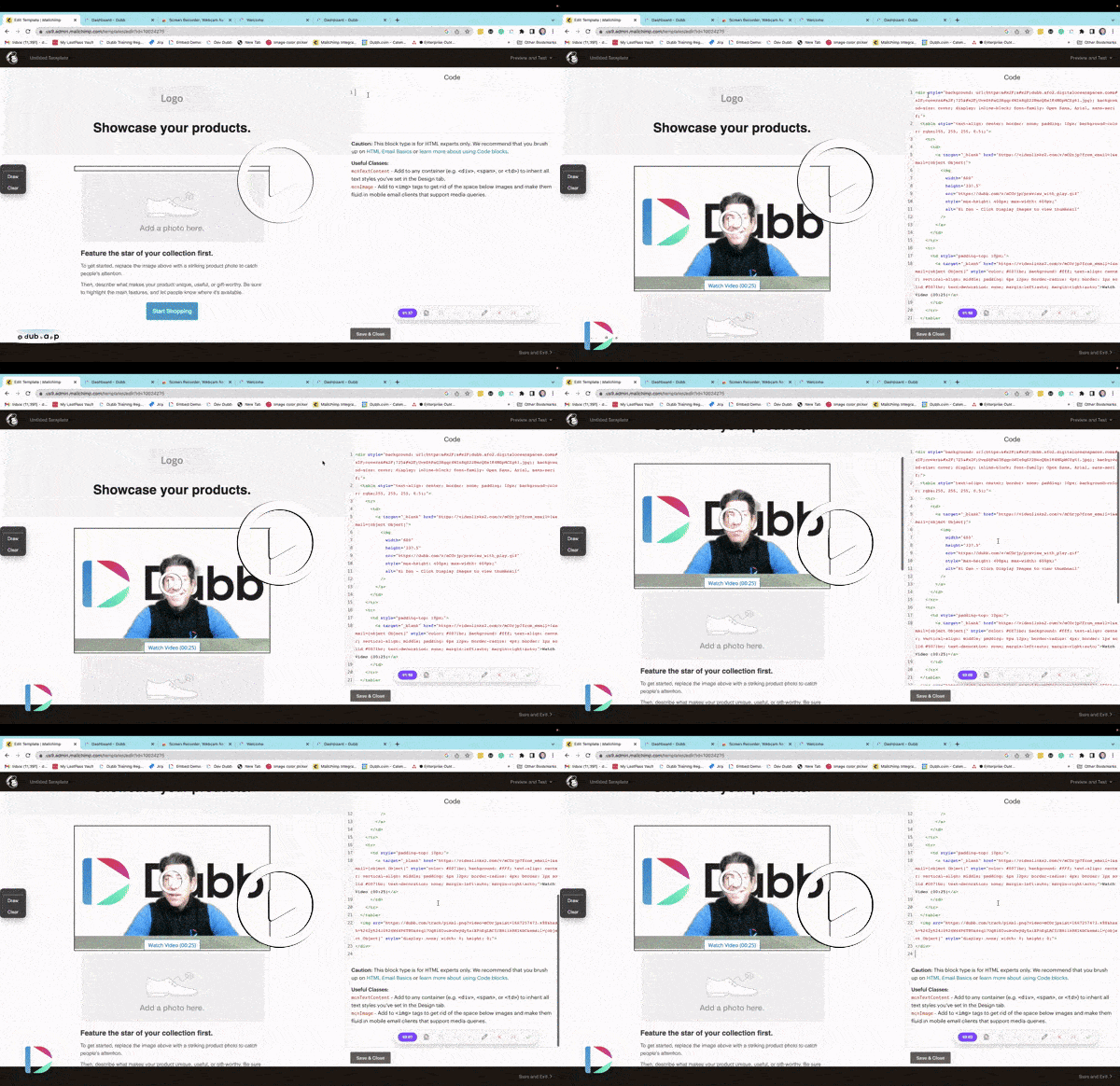
In the Mailchimp editor, drag an Image block into your email template. Upload a thumbnail image or an animated GIF that represents your video (see the next section for guidance on choosing between these). Select the image block, then use the “Link” field to paste your Dubb video URL.
Step 7. Add a Play-Button Overlay (Optional but Recommended)
For static thumbnails, adding a semi-transparent play button icon on top of the image makes the interactive intent immediately clear to recipients. This can be done in any image editor before uploading the thumbnail to Mailchimp.
Step 8. Test Before Sending
Send yourself a test email and verify the thumbnail renders correctly and the link opens the Dubb video page. Check rendering in at least two email clients before deploying to your full list.
Choosing the Right Thumbnail: Static Image vs. Animated GIF
Both formats work with this workflow. The choice depends on your audience, brand voice, and the nature of the video.
| Format | Best For | Pros | Cons |
|---|---|---|---|
| Static PNG/JPG thumbnail | Professional B2B campaigns, formal announcements | Fast load time, consistent across all clients, easy to produce | Less visually dynamic; requires clear CTA text or play-button overlay |
| Animated GIF | Product demos, event promotions, consumer-facing campaigns | Higher perceived engagement; shows product in motion; eye-catching | Larger file size can slow load; Outlook 2013–2019 shows only the first frame |
| Cinemagraph | High-end brand storytelling | Premium feel; subtle motion draws attention without distraction | Requires design skill to produce; same Outlook first-frame limitation applies |
One practical rule worth noting: if a significant share of your list is corporate, the odds of Outlook rendering your GIF’s animation drop meaningfully. Always design the first frame of any GIF to function as a complete, compelling standalone image. That first frame is what Outlook users will see.
Video-in-Email Tool Comparison
Several platforms support the thumbnail-to-hosted-video workflow. The tools below each integrate with Mailchimp or similar ESPs and represent the main options in this category.
| Tool | Primary Use Case | Mailchimp Integration | Recording Capability | Official Site |
|---|---|---|---|---|
| Dubb | Sales and marketing video workflows; record, host, and link video from Chrome | Via Chrome Extension; manual URL insertion into Mailchimp image blocks | Yes – screen, webcam, or upload via Chrome Extension | dubb.com |
| Loom | Async video messaging; quick screen and webcam recordings | Manual URL insertion; Loom generates a shareable link and auto-thumbnail | Yes – screen, webcam, or both | loom.com |
| Vidyard | B2B video for sales outreach and marketing; deep CRM integrations | Via Vidyard’s native Mailchimp integration (available in paid plans) | Yes – screen, webcam, or upload | vidyard.com |
| BombBomb | Video email specifically; designed for real estate, financial services, and relationship-based selling | Direct Mailchimp integration; generates embed-ready thumbnails automatically | Yes – webcam-focused | bombbomb.com |
Dubb and Loom work best when the sender wants a fast, low-friction recording and sharing workflow. Vidyard is better suited for teams that need video analytics integrated into a CRM like Salesforce or HubSpot. BombBomb is the strongest fit for high-volume, relationship-driven email use cases where video is the primary channel rather than a supplement.
Best Practices for Video in Email Campaigns
Keep subject lines video-forward. Including the word “video” in an email subject line is consistently associated with higher open rates across multiple email benchmarking studies. Campaign Monitor’s research and similar industry reports have observed this pattern, though the magnitude varies by list and industry.
Match thumbnail to video content. Use a frame from the actual video not a stock image as the thumbnail. Recipients who feel misled by a thumbnail that doesn’t match the content are less likely to engage with future emails.
Put the video link high in the email. Many recipients skim or read only the top portion of a campaign. A video placed below three paragraphs of text will see significantly fewer clicks than one placed in the first content block.
Add alt text to the image block. In email clients where images are blocked by default, a recipient with images turned off will see nothing if alt text is missing. Write alt text like "Watch: [Topic of Video] - click to view" to preserve the call-to-action even in image-blocked environments.
Test in multiple clients before sending. At minimum, check Gmail (desktop and mobile), Outlook desktop, and Apple Mail. Tools like Litmus or Email on Acid provide automated cross-client testing.
One discipline worth building early: always review the GIF’s first frame in isolation before uploading to Mailchimp. It is easy to compose an animated thumbnail where the meaningful moment appears mid-sequence and Outlook will show only that static first frame to a large portion of your enterprise audience.
Common Mistakes and How to Fix Them
Linking the image to the video file instead of the hosted video page. A .mp4 URL will not play in a browser the way a hosted landing page will. Always link to a Dubb page URL (or equivalent hosted page), not the raw file.
Using a GIF over 1MB without compression. Large GIFs increase email load time and can cause some clients to drop the image entirely. Mailchimp’s image guidelines recommend keeping all images under 1MB. Use tools like ezgif.com or Gifsicle to compress animated GIFs before uploading.
Forgetting the play button overlay. Without a visual cue that the image is clickable, many recipients will not know the thumbnail leads to a video. A simple play button icon increases perceived affordance and click-through rates.
Not tracking clicks separately. Mailchimp tracks link clicks automatically, but if you have multiple links in a campaign that lead to video, name them distinctively. Review click map data after each send to understand which video placement is driving the most engagement.
Using a low-resolution thumbnail. Mailchimp scales images to fit the column width of your template. Use a thumbnail of at least 600px wide to avoid pixelation on retina displays.
Proof: Why This Actually Works
A cohort of sales development representatives at a mid-market SaaS company adopted a video-in-email workflow for cold outreach sequences delivered through Mailchimp. The team consisted of approximately 12 SDRs across two product lines targeting IT decision-makers.
Prior to the change, their email sequences used text-only follow-ups after an initial outreach message. Click-through rates on follow-up emails were consistently below 3%.
After introducing a video thumbnail in the second email of each sequence a 60-to-90 second personalized intro recorded via a screen-and-webcam tool the team observed a directional increase in reply rates and click-throughs on follow-up messages. Qualitative feedback from prospects referenced the video as a primary reason for responding. Time-to-first-reply shortened noticeably compared to the prior quarter.
Outcomes were directional rather than statistically controlled, as the team did not run a strict A/B test. However, the results were consistent enough across both product lines that the team standardized the video step as part of all outreach sequences within one quarter.
Based on self-reported workflow changes and Mailchimp click data from a team of 12 SDRs at a single company, observed over a single quarter, using campaign-level click metrics.
FAQ
Does Mailchimp support embedded video?
No. Mailchimp does not have a native video embed block, because HTML5 video is not reliably supported across major email clients. The recommended approach is to host your video externally, create a clickable image inside the Mailchimp editor, and link that image to your hosted video URL. This gives recipients a seamless one-click experience without relying on in-email video playback.
Can I use a YouTube or Vimeo link in Mailchimp?
Yes, but with caveats. You can link a thumbnail image to any YouTube or Vimeo URL, and clicking it will open the video in a browser. However, YouTube and Vimeo pages have their own branding, ads, and suggested-video sidebars that may distract from your message. Platforms like Dubb, Vidyard, or Loom provide cleaner branded playback pages with fewer competing distractions and built-in analytics.
What is the best image size for a video thumbnail in Mailchimp?
Mailchimp recommends images no larger than 1MB. For sharpness on high-resolution displays, use a thumbnail at least 600px wide. A 16:9 aspect ratio (e.g., 600×338px) works well for video thumbnails and aligns with standard video dimensions.
Does adding the word “video” to a subject line improve open rates?
Multiple industry studies have observed higher open rates on emails that include “video” in the subject line. Syndacast reported open rate increases of up to 19% in tests using the word “video” in the subject line, though results vary by list quality, industry, and deliverability reputation. Subject line testing on your specific list is the most reliable way to measure the effect.
Will animated GIFs play in all email clients?
No. Outlook 2013 through 2019 on Windows renders only the first frame of an animated GIF. Apple Mail, Gmail, and most mobile clients render GIF animation correctly. Always design the first frame of any GIF to function as a complete standalone image with a clear call to action, so Outlook recipients still receive a usable message.
Is the Dubb Chrome Extension free?
According to information available from Dubb’s website, a free account tier is available and the Chrome Extension can be installed at no cost. Refer to dubb.com for current pricing and feature availability, as plan details may change.
How do I track whether recipients watched the video?
Mailchimp tracks clicks on the thumbnail link, which tells you how many people clicked through to the video page. For view depth and watch time, you need analytics from the video hosting platform itself. Vidyard and Dubb both offer view tracking on hosted video pages. YouTube and Vimeo provide basic view analytics on public videos.