Dubb Chrome Extension: Record Screen and Webcam
Have you ever felt stuck spending too much time chasing prospects instead of closing deals? If so, you're not alone. Many sales professionals struggle to get responses from emails and calls. But what if you could shift your approach using a Chrome screen recorder to capture and share your value in a more engaging, visual way?
Or perhaps you're not struggling with chasing leads, but are tired of having to write long emails. If you’ve ever needed to explain a process, capture a bug, or walk someone through a webpage, recording your screen is faster and more convenient than coming up with long-winded emails.
Using a screen recorder allows you to record your screen to create personalized, high-quality videos that resonate with prospects. This blog explains how a Chrome extension can make screen recording easy and effective, transforming your sales process from chasing to attracting.
Why Use a Chrome Screen Recorder for Sales?
Traditional sales outreach often feels like a grind. But by using a screen recorder Chrome extension, you can showcase your insights, proposals, and competitive analyses through video. This visual approach helps prospects better understand your message and see you as an expert.
Research shows that video emails can increase click-through rates by over 300% compared to standard emails. A Chrome screen recorder lets you capture these high-quality videos with audio and webcam integration to make your outreach more personal and professional-looking.
How to Start Using a Chrome Screen Recorder
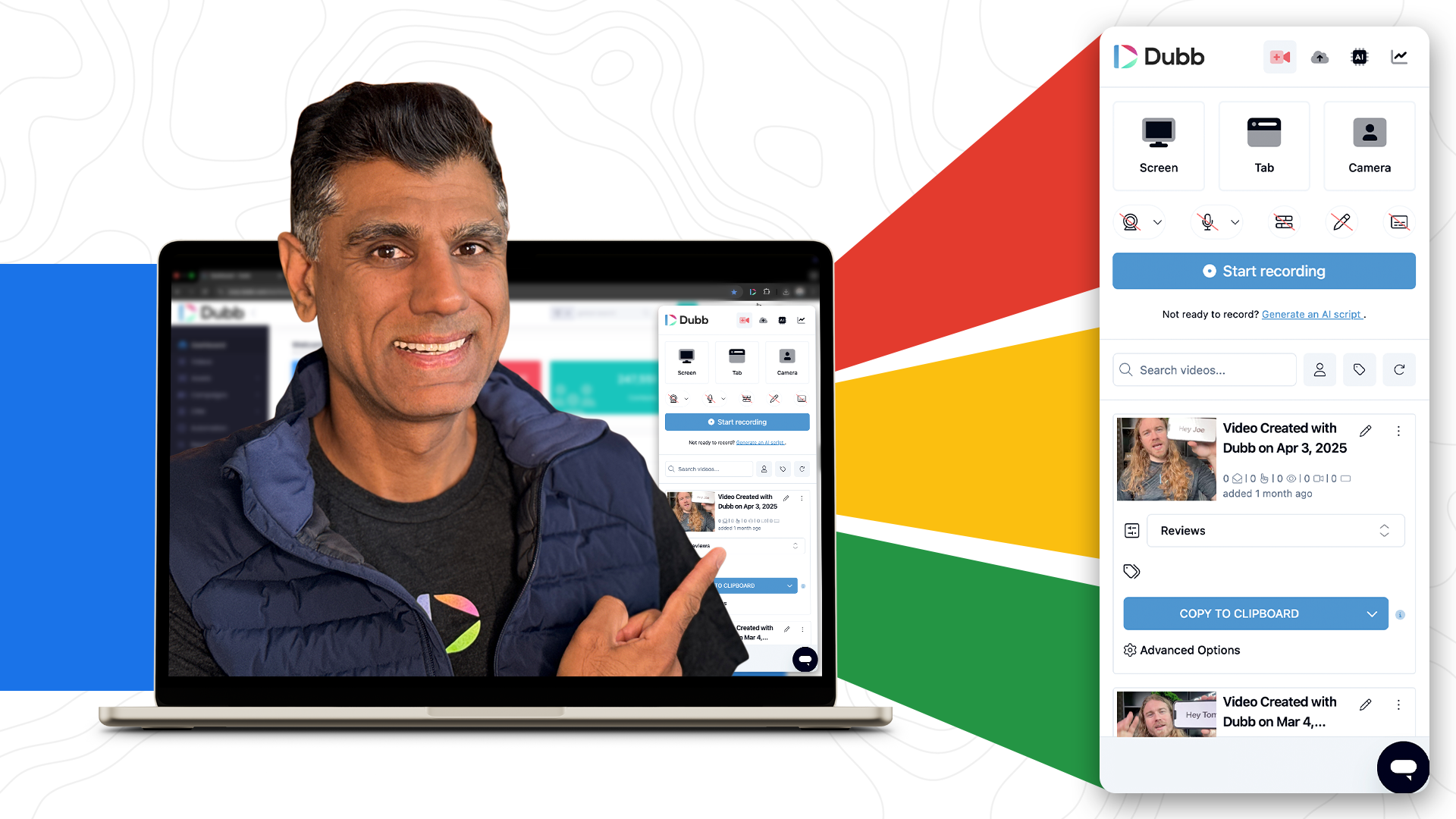
Open the Dubb extension from your Chrome toolbar, choose screen, camera or both, and hit record. One click stops it, the video uploads itself, and you get a link you can paste into email, LinkedIn or a text. From there you can see who opened it and how far they got.
1. Choose the Best Recorder Chrome Extension
The first step is installing a Chrome extension for screen recording.
There are dozens of extensions available on the Chrome Web Store, but only one combines screen capture, annotations, recording, and business-grade CTAs in a single, powerful package: Dubb.
2. Plan What to Screen Record
Decide what you want to share. It could be:
-
A Google Slides deck
-
A PDF proposal
-
A browser tab with competitor analysis
-
A demo of your software workflow
Using annotations helps highlight key points during your recording. This keeps your video focused and professional.
3. Record Your Screen with Audio and Webcam
A powerful Chrome screen recorder lets you capture system audio, microphone input, and webcam footage simultaneously perfect for combining screen and camera to create engaging content. The ability to pause during recording lets you build concise, high-quality videos without lengthy editing later.
4. Upload, Edit, and Share Your Video
After recording, upload your video (usually in MP4 format) to a cloud platform or your sales tool, such as Dubb. With Dubb, you can edit your video, add automatically generated captions, and create a landing page with clear calls to action (CTAs) like booking meetings or filling out forms.
For better engagement, try embedding an animated GIF preview in your emails. This boosts click-through rates by giving recipients a sneak peek before they watch the full video.
5. Track Engagement for Smarter Follow-Ups
One of the key advantages of using Dubb’s Chrome screen recorder is its powerful tracking and analytics feature, which lets you see exactly who watched your video, how long they engaged, and who clicked on your CTAs. This insight enables you to prioritize prospects with genuine interest, making your follow-ups more targeted and effective, so you spend less time chasing cold leads and more time closing deals.
What to Record, by Use Case
A screen recording is a message with a window attached. The recording is only useful if the viewer knows what to look at, so the first ten seconds decide whether the rest gets watched. Here is how the same tool gets used for the five jobs it covers best.
A bug report
Record the steps, not the conclusion. Open the page, click the three things that break it, and narrate what you expected at each step. A 40 second recording with the console open replaces a written report that takes twenty minutes to write and three messages to clarify. Stop recording the moment the bug appears, so the developer does not have to hunt for it.
A product walkthrough
Choose one path through the product and stay on it. If the video is about the reporting screen, do not detour into settings because you are passing them. Move the cursor slowly, pause on the element you are describing, and use a bubble so the viewer can see that a person is guiding them rather than a slideshow running.
An onboarding or process video
This is where screen recording pays back the fastest, because the same question gets asked by every new hire. Record the process once, in the order it actually happens, and keep the video under five minutes. Then put the same steps in text under the video, so a returning viewer can skim instead of rewatching.
Explaining a document
Open the proposal, the quote or the contract on screen and talk through the three lines that usually cause a question. The viewer can see the number you are defending while you defend it, which is why this works better than a call and better than an email. Keep your face in the corner; the document is the subject, you are the guide.
Answering a support question
Record the answer to the exact question in the exact account, with the customer's own screen state visible. A generic help article makes them translate; a recording of their own data makes the fix obvious. This is also the moment to turn the recording into the help article, because you just wrote and demonstrated the answer in one pass.
Audio, Resolution and File Size
Bad audio sinks more recordings than bad video. Viewers tolerate a slightly soft picture; they will not tolerate a room that sounds like a bathroom, or a microphone that clips every time they say a number.
- Use a headset or a USB microphone. The microphone in a laptop picks up the fan and the room. A wired headset fixes most of it for the price of a coffee.
- Record a five second test first. Play it back on speakers, not headphones. If you can hear the room, move or change the input device before you record the real thing.
- Capture the tab, not the desktop, unless the point of the video crosses applications. A tab capture keeps notifications and your personal browser bar out of the frame.
- Record at 1080p. Higher resolution mostly buys you a bigger file and a slower upload. Text on a 1080p recording is readable on a phone when the viewer is watching a window that fills the frame.
- Keep the frame rate default. Thirty frames per second is enough for a walkthrough. Sixty is for motion, and a cursor moving across a static screen is not motion.
File size follows from those choices. A ten minute screen recording at 1080p is comfortably shareable when it is streamed from a hosted page, and awkward when it is exported and attached to an email. If the file is what you are sending, cut the recording rather than compressing it into mush.
Sharing, Access and Privacy
A screen recording can leak more than you intend. Tabs, email previews, customer names, a Slack notification with a candidate's salary in it. Two habits prevent nearly all of it.
First, tidy the screen before you press record. Close the personal tabs, silence notifications, and check the window title bar, which often carries a document name. Second, decide who should be able to open the link before you send it. A recording of a customer's account should not be publicly viewable, and a recording of an internal process should not sit behind a link anyone can guess.
When you share, say what is in the video in the message. "Two minutes on the billing error, your account only" tells the viewer it is safe and specific, and it tells them whether they need to watch now or later. If the video contains anything sensitive, send it to a named person rather than a channel, and take it down when the question is resolved rather than leaving it live indefinitely.
Keeping a Recording Library
The second recording of the same process is the one that costs you. If three people have each recorded the same onboarding walkthrough, you have three versions, two of them wrong, and a new hire who does not know which to trust.
Keep one place for the videos that get reused and name them the way someone would search: "onboarding, first login", "support, refund flow", "demo, reporting screen". Add the date to anything that describes a product that changes, and delete the old version the day the new one ships. A library with two versions of everything is worse than no library, because the viewer cannot tell which one is current.
For the videos that go to one person, do not file them at all. Record, send, and let the tool hold the link and the watch data. The library is for the ten or twenty recordings that will be watched by people you never meet.
Frequently Asked Questions About Chrome Screen Recorders
Q: Is there a completely free screen recorder Chrome extension?
A: Yes. Extensions like Screencastify offer free tiers with watermarking and limited recording time, while others like Dubb provide unlimited videos without watermarks.
Q: Can I capture audio and webcam along with my screen?
A: Most modern screen recorders for Chrome support capturing audio from your mic and system sound, plus webcam footage.
Q: How do I download and share my recordings?
A: After recording, you can download your video as an MP4 file or directly share a link hosted in the cloud for seamless sharing.
Q: Can I edit my screen recordings?
A: Many Chrome extensions include basic video editing features like trimming, annotating, or adding captions for polished content.
Does the Dubb Chrome extension record system audio?
It can capture tab audio when you choose that source, and it captures your microphone separately. If you need both at once, check the levels in a ten second test before the real recording.
How long can a Chrome screen recording be?
There is no hard timer inside the extension, but long sessions are limited by the tab staying awake and the machine staying responsive. Past roughly ten minutes, the desktop app is the safer choice.
Can I record a screen without the webcam bubble?
Yes. Screen only is one of the modes. The bubble is a choice, not a default you are stuck with.
Why is my screen recording silent?
Most often the wrong audio source is selected, or the microphone is muted in the operating system rather than in the recorder. Check the OS input device first, then the recorder's source setting.
Four recording modes, and when to use each
Most people record in the default mode forever and then wonder why the video looks wrong on a phone. Pick the mode from the destination backwards.
| Mode | What the viewer sees | Use it for | Avoid it when |
|---|---|---|---|
| Screen only | Your screen, full frame | Product walkthroughs, dashboards, documents | You need to establish trust quickly |
| Screen plus webcam bubble | Screen, with you in a corner | Demos, tutorials, support replies | The screen is the whole message and the bubble covers content |
| Webcam only | You, full frame | Intro, follow up, congratulations, bad news | You are explaining something visual |
| Tab with system audio | The browser tab plus its sound | Recording a webinar, a call, a video that has audio | You need your own voice over the top, because the mic picks up both |
When Chrome blocks the screen, the mic or the camera
| What you see | Cause | Fix |
|---|---|---|
| Recording starts with no picture | Chrome denied the capture at the prompt | Click the padlock in the address bar, allow screen share and camera, then reload the tab and start again |
| Silent recording | Wrong audio source selected, or the mic is muted at the OS level | Check the OS input device first, then pick the right source in the recorder |
| Bubble sits over the content you need | Default bubble position | Move the bubble before recording, or switch to screen only for that clip |
| Recording stops on its own | Tab backgrounded or machine went to sleep | Keep the tab in front and disable sleep for long recordings |
| Choppy playback | Recording a high resolution screen on a loaded machine | Record at 1080p rather than native 4K, and close heavy tabs |
Chrome extension or desktop app
Use the Chrome extension when the video lives inside the browser: a dashboard, a document, a web app you are demonstrating to one person.
Use the desktop app when the recording is long, when you need system audio cleanly, when the content spans several apps, or when the connection is unreliable. Long clips and 4K are better handled outside a browser tab.
Both end in the same library, with the same tracking. The extension is faster to start; the app is steadier to finish. If you record the same thing every week, install both and stop thinking about it.
Related reading: webcam bubble screen recording, annotating screenshots, and the six ways to upload a video once it is recorded.
Why Choose a Chrome Extension for Screen Recording?
Using a Chrome extension for screen recording offers several advantages:
-
Seamless integration with the Chrome browser for easy access anytime.
-
Lightweight tools that don’t require heavy software installs.
-
Ability to record browser tabs, full screen, or desktop effortlessly.
-
Instant upload and sharing options to streamline your workflow.
-
Support for high-quality video and audio recording for professional results.
-
Some extensions support AI features for auto-transcription and smart editing.
Final Tips for Maximizing Your Chrome Screen Recorder
-
Keep videos short and packed with value, under 2 minutes is ideal for high watch rates.
-
Use the pause feature to create smooth transitions and avoid unnecessary footage.
-
Add annotations to emphasize important details.
-
Experiment with different extensions for Chrome to find the one that best fits your style and workflow.
-
Use your Chrome recorder tool daily to build familiarity and confidence.
Related reading: text to video, video in Outlook email and video in Gmail.
Start Recording Your Screen Today with Dubb’s Chrome Screen Recorder
Ready to effortlessly capture and share high-quality videos with prospects? Dubb’s Chrome extension offers an easy-to-use, powerful screen recorder tool designed for sales professionals, educators, and teams.
With Dubb, you get unlimited video recording, seamless video editing, and tracking to optimize your outreach, all integrated within the Chrome browser for maximum efficiency.
Sign up for a free account to Dubb and download the free Dubb Chrome extension today from the Chrome Web Store to start transforming your sales workflow!
Record from the tab you are already in
The Dubb extension records the screen, the camera or both, then hands you a tracked link instead of a download.