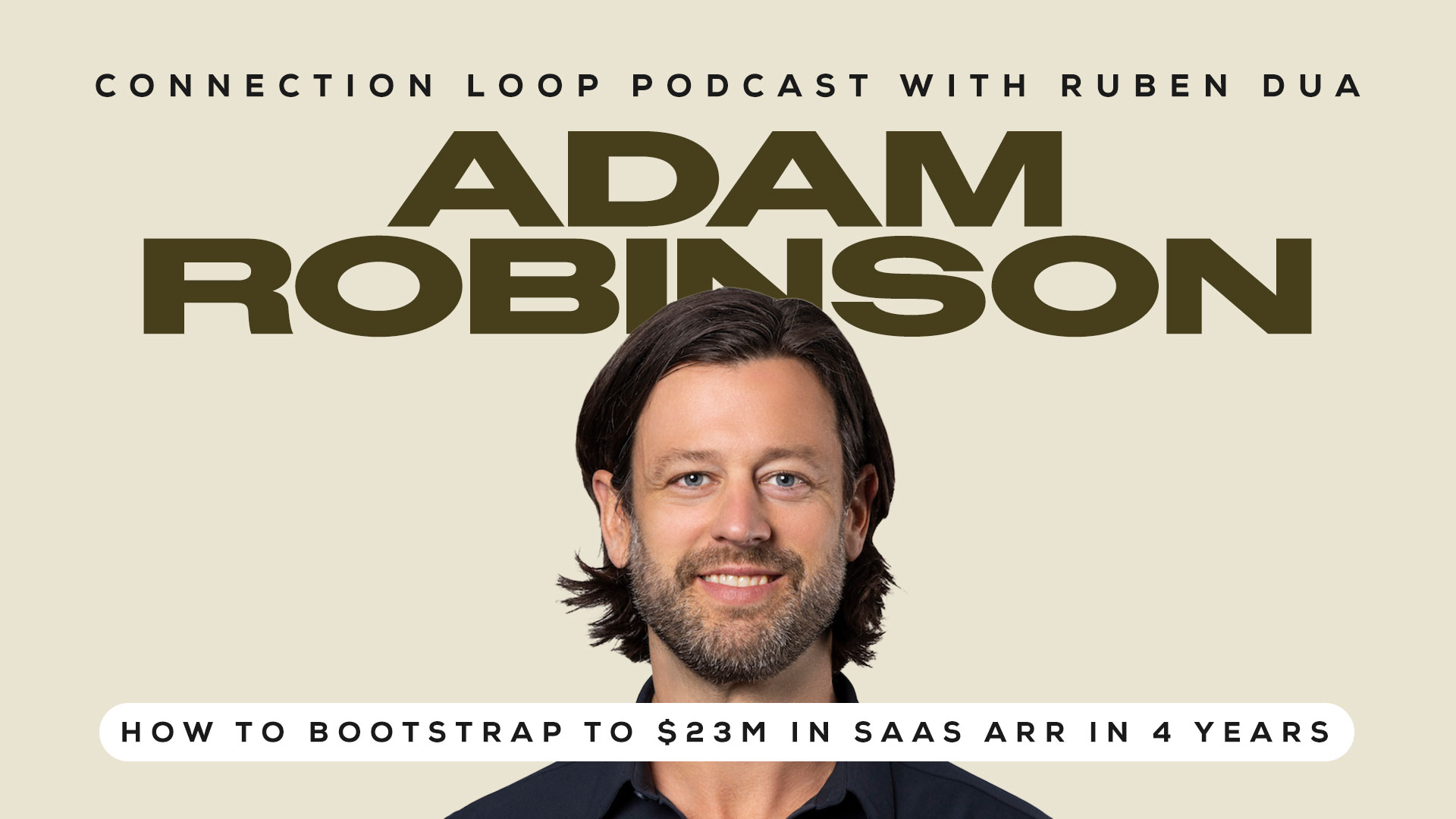
How Adam Robinson Bootstrapped to $23M ARR in 4 Years
Adam Robinson took a second SaaS company from zero to $23 million in annual recurring revenue in four years without raising the way his competitors did. The interesting part is not the number. It is what happened before it: a first company that stalled at $3 million ARR and stayed there.
In this episode of Connection Loop he walks through the stall, the three years of trying things that did not work, and the idea that finally did: Retention.com, which identifies website visitors at person level for ecommerce brands.
The slow ramp of death
A company that stalls at a few million in ARR is not failing in a way anyone can see from outside. It has customers, a team and a product people use. It simply stops compounding, and every new hire adds cost faster than it adds revenue.
Three things usually keep a founder in that plateau longer than they should:
- The market is big enough to survive in, so nothing forces a decision.
- The product keeps improving, which feels like progress and does not change the growth rate.
- The next experiment is always cheaper than the pivot, so the experiments accumulate without a verdict.
Adam spent three years in that loop before the second company. The useful lesson is not "persevere". It is that he eventually changed the wedge, not the effort.
The pivot that worked
Retention.com attacked a problem his first company could not: getting identity from visitors who never filled out a form. That is a wedge, not a platform. It is narrow enough that a buyer recognises the problem instantly, and painful enough that they pay to make it stop.
Two things make a wedge work, and both are visible in that example:
- It is one job, described in a sentence a buyer could repeat to their boss.
- It compounds into retention. The software makes the customer better at keeping the customers they already paid to acquire.
What a bootstrapper should copy
The strategy is not "find a data product". It is the sequence:
- Pick a problem with a cost the buyer already measures.
- Sell the one job before you build the platform around it.
- Price so the first ten customers fund the next ten.
- Only widen after the wedge is compounding, not because the roadmap looks thin.
The part most founders skip is the last one. Widening early feels like ambition and usually resets the clock, because the message has to be rewritten for a buyer who was never the wedge buyer.
Testing the wedge with video
A wedge is a claim about a specific buyer. The fastest way to test a claim is to say it out loud to that buyer and watch what happens, which is exactly what a recorded video gives you.
- Record a 90 second version of the wedge claim: who it is for, the problem, the outcome, and one next step.
- Send it to twenty prospects who match the narrow version of the buyer and to nobody else.
- Read the watch data. Replies are a signal. Watching to the end without replying is a different signal, and usually means the problem landed but the offer did not.
Dubb records the clip, puts it on a page with one call to action, and reports the named viewer and the watch depth, so the wedge test produces evidence in a week instead of a quarter of interviews.
What to do this week
- Write the wedge claim in one sentence and underline the cost it removes.
- Send the recorded version to twenty narrow-fit prospects.
- Decide the verdict on the watch and reply data before you change the product again.
Listen, then send the follow up
Take the one idea you are taking from Adam, record ninety seconds on it, and send it to the prospect who needs to hear it.
Frequently asked questions
What is the slow ramp of death?
A plateau where a company has real customers and real revenue but stops compounding, so each new hire adds cost faster than growth. It is survivable, which is why founders stay in it too long.
What is a wedge in SaaS?
One narrow job, described in a sentence a buyer could repeat, that a specific buyer will pay to solve. It is deliberately too small to be a platform, because the narrowness is what makes the message land.
When should a bootstrapped company widen its product?
After the wedge is compounding on its own numbers, not when the roadmap starts to look thin. Widening early resets the clock because the message has to be rewritten for a different buyer.
Listen to the full conversation below, and if you want the follow up workflow in detail, the automation guide is here.
Visit ai.dubb.com/signup/cl-podcast for more episodes.
The story continues on dubb.com.
Listen to the full podcast here:
Listen to this podcast on the platform of your choice here.
Learn more about Dubb at https://dubb.com/

Subscribe to Dubb’s Connection Loop Podcast
Connection Loop is a podcast hosted by Dubb Founder, Ruben Dua. The show focuses on the stories of leaders, innovators, and friends , all in a conversational format. This show is brought to you by dubb.com.