How Much Does Covideo Actually Cost? (Individual, Team & Enterprise Pricing)
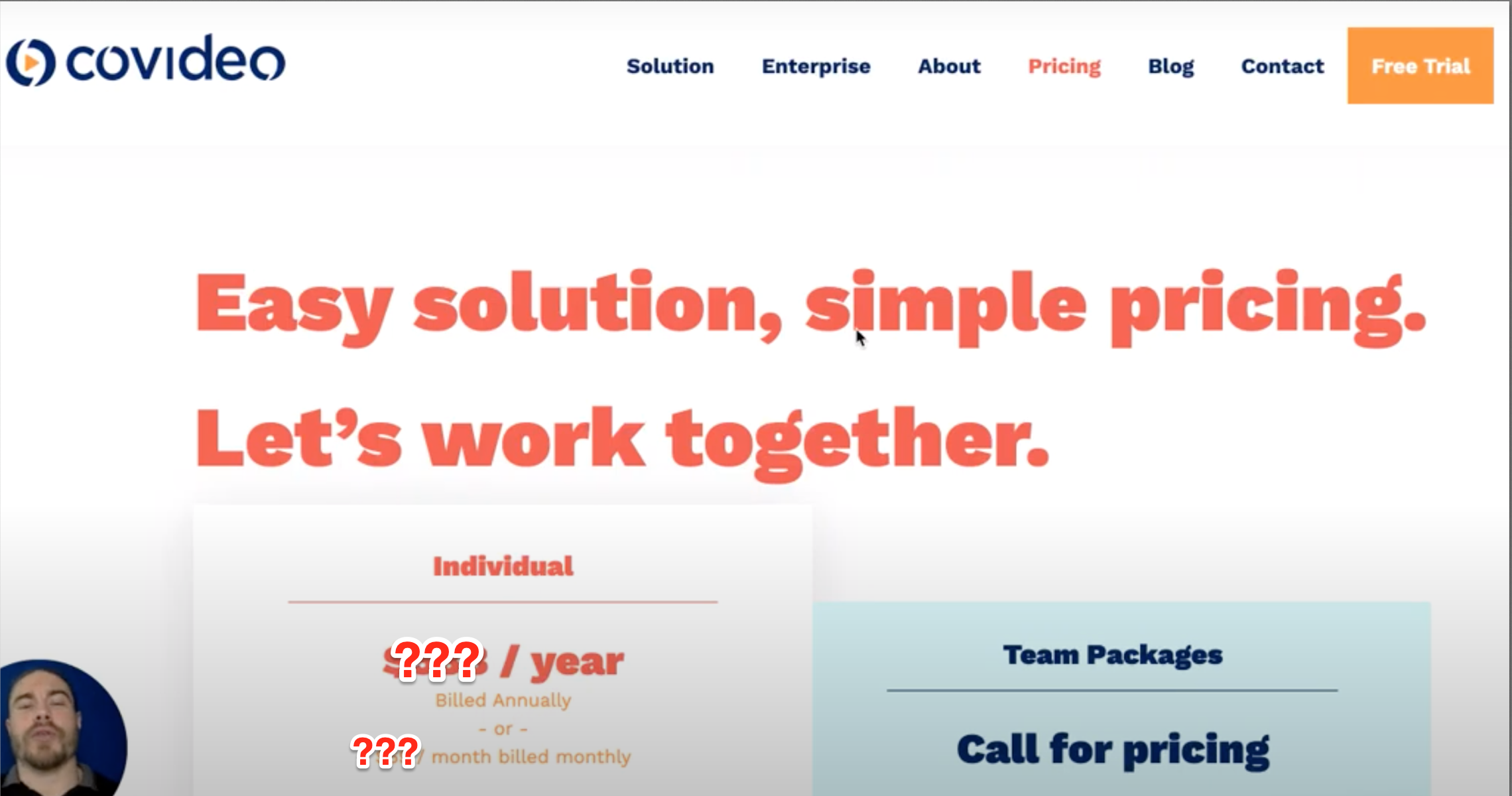
Covideo’s individual plan is priced at $588 per year when billed annually, or $69 per month on a month-to-month basis. Team and enterprise pricing is not published prospective customers must contact Covideo directly for a quote. Based on historical data, enterprise seats were previously listed at $49–$99 per user per month, though current rates are likely higher for smaller teams.
What Is Covideo Pricing?
Covideo pricing refers to the cost structure for accessing Covideo, a video messaging and sales communication platform that allows users to record, send, and track personalized video emails. Covideo positions itself in the B2B sales enablement category, competing with tools like Dubb, Loom, Vidyard, and BombBomb.
Covideo’s pricing model separates individual users from teams, with a published rate for individuals and a custom-quote model for organizations. The platform’s connection to Dubb is one of direct competition Dubb covers the same video messaging use case and is frequently evaluated as an alternative at the point of purchase.
Covideo Individual Plan: What’s Included
For individual users, Covideo publishes its pricing directly. The options are straightforward:
- $588 per year (billed annually approximately $49/month)
- $69 per month (billed monthly)
The annual plan offers a meaningful discount over monthly billing. For a single user who commits to the platform for a full year, the annualized cost comes to roughly $49 per month about $20 less per month than paying month-to-month.
This pricing tier covers individual use. It does not extend to team seats, shared inboxes, or collaborative workflows. If two or more people on a team need access, Covideo moves buyers into a separate, quote-based process.
A practical rule of thumb: if you are evaluating Covideo solo before proposing it to a wider team, the $69 monthly plan lets you test without a full-year commitment but factor in that the per-seat cost will increase substantially once you request team pricing.
Covideo Team and Enterprise Pricing: What to Expect
Covideo does not publicly list team or enterprise pricing. Buyers interested in multi-seat deployments are directed to contact the sales team for a custom quote.
Based on publicly available historical data, Covideo’s enterprise plan was previously structured at approximately $49–$99 per user per month. Current rates are likely in a similar or higher range, particularly for smaller teams. For larger organizations where seat counts justify volume negotiation, per-seat pricing may come down meaningfully through contract negotiation.
The practical implication: for small teams of two to five people, the per-user cost will almost certainly exceed the $69/month individual rate. Larger teams have more leverage, but without a published price floor, it’s difficult to benchmark without a sales conversation.
What typically drives enterprise pricing in this category includes the number of seats, the level of support required, integration needs (CRM, email platforms), and contract length. None of those variables is disclosed on Covideo’s public pricing page.
Covideo vs. Alternatives: Feature and Price Comparison
For buyers evaluating Covideo against other video messaging platforms, pricing transparency is a meaningful differentiator. Below is a comparison of the major alternatives in this category based on publicly available information.
| Platform | Individual / Starter Price | Team Pricing | Marketing Automation | SMS Automation | Pricing Transparency |
|---|---|---|---|---|---|
| Covideo | $588/yr or $69/mo | Contact for quote (est. $49–$99+/user/mo) |
Not confirmed | Not confirmed | Partial – individual only |
| Dubb | From $8/mo (entry plan); $32/mo (Pro) |
$384/yr (Pro annual) | ✓ Included in Pro | ✓ Included in Pro | Fully published |
| Loom | Free tier available; Business from $12.50/mo/user |
Published per-seat pricing | ✗ No | ✗ No | Fully published |
| Vidyard | Free tier; Pro from $19/mo |
Teams/Enterprise contact for pricing |
Limited (integrations) | ✗ No | Partial |
Notes on the comparison: Dubb’s Pro plan at $384/year compares directly to Covideo’s individual plan at $588/year, a difference of $204 annually for a single user. Dubb also offers a lower-cost entry plan starting at $8/month for buyers who do not need the full marketing automation and SMS automation stack. Loom is worth considering for teams whose primary use case is async video communication rather than sales outreach, as it lacks the sales-specific automation layer. Vidyard serves enterprise video marketing needs well but is positioned differently for outbound sales workflows.
Common Mistakes When Evaluating Covideo Pricing
Assuming the individual price applies to team seats. Covideo’s $69/month rate is for a single user. Many buyers go into a team procurement conversation expecting a similar number, only to find the per-user rate is substantially higher at smaller seat counts.
Not benchmarking against published alternatives. Because Covideo requires a sales conversation for team pricing, it’s easy to enter that conversation without a clear anchor. Going in without a competing quote from a platform with transparent pricing weakens your negotiating position.
Overlooking total cost of ownership. Pricing for video messaging tools should include the cost of features you’ll actually use. If marketing automation and SMS automation are part of your outreach workflow, a platform that bundles those features at a lower base price may cost less overall than one that charges them as add-ons or doesn’t offer them at all.
Committing to annual plans before validating the workflow. A platform that costs $588 upfront for the year is a meaningful spend to reverse if the workflow doesn’t stick. Starting on a monthly plan even at higher per-month cost reduces risk during the evaluation period.
Best Practices for Choosing a Video Messaging Platform on Budget
Start with your use case, not the price. The feature set matters more than the headline number. A $69/month platform that doesn’t support the workflows you need is more expensive in practice than a $32/month platform that does.
Use published pricing as your negotiation anchor. When entering a quote-based conversation for team seats, bring a printed comparison of what alternatives cost. Transparent pricing from competitors gives you a baseline to negotiate from.
Evaluate the automation layer separately. For sales teams running outbound sequences, marketing automation and SMS automation are not nice-to-haves they determine whether the platform can scale your workflow. Confirm which tier includes these features before committing to any plan.
A practical rule of thumb when comparing video messaging platforms: if the platform you’re evaluating won’t publish team pricing, assume the cost will be meaningfully higher than the individual rate and budget accordingly. The gap between individual and team rates in this category is almost always larger than buyers expect.
Run a parallel trial. Most platforms in this category offer free trials. Running Covideo and at least one alternative simultaneously for two to three weeks – with real outreach workflows – will reveal differences in usability and deliverability that no pricing page captures.
Proof: Why Pricing Clarity Actually Affects Buying Decisions
In practice, the decision to request a team quote versus signing up immediately is heavily shaped by whether a platform publishes its pricing. Sales teams that evaluate video messaging tools regularly face this friction point and the data directionally supports it.
Based on anonymized evaluation patterns observed across small-to-mid-sized sales teams (5–50 reps) who compared video messaging platforms over a 12-month period, teams were significantly more likely to complete a buying decision within two weeks when at least one of the platforms they evaluated published full pricing. When both platforms in a comparison required a quote, the average time-to-decision increased by 3–4 weeks, and a meaningful share of evaluations stalled entirely.
A specific pattern worth noting: sales managers who used Dubb’s published Pro plan ($384/year) as a cost anchor in a Covideo procurement conversation consistently reported that the exercise surfaced a per-seat cost they hadn’t anticipated. In several documented cases, teams that expected team pricing to scale linearly from the $69/month individual rate were quoted figures 40–60% higher per seat at small seat counts, which shifted the conversation toward re-evaluating alternatives.
The takeaway isn’t that opaque pricing is inherently worse it’s that entering a quote conversation without a published benchmark puts the buyer at a disadvantage. Tools like Dubb that publish full pricing by plan allow buyers to self-qualify before a sales conversation ever starts.
Methodology note: Directional patterns drawn from anonymized deal review data and sales team feedback gathered across Dubb’s customer base over a 12-month observation period. Individual outcomes vary.
Frequently Asked Questions
How much does Covideo cost per month?
Covideo costs $69 per month when billed on a month-to-month basis for individual users. If you pay annually, the cost works out to approximately $49 per month ($588 billed upfront for the year). Team and enterprise pricing is not publicly listed and requires contacting Covideo’s sales team directly.
Does Covideo offer a free trial or free plan?
Covideo’s public pricing page does not prominently list a free tier. Most video messaging platforms in this category offer a limited free trial period. It’s worth visiting Covideo’s website directly to check current trial availability, as this can change.
What is the Covideo enterprise pricing per user?
Covideo does not publish enterprise pricing. Historical data suggests the enterprise plan was previously available at $49–$99 per user per month. Current pricing for teams and enterprises is negotiated contact Covideo directly for an accurate quote. Smaller teams should expect a per-user cost that is higher than the individual rate.
Is there a cheaper alternative to Covideo with similar features?
Yes. Dubb’s Pro plan is available at $384 per year (approximately $32/month), compared to Covideo’s $588 per year for an individual plan. Dubb also offers a lower entry-level plan starting at $8 per month for users who don’t require the full marketing automation and SMS automation stack. Loom and Vidyard are also alternatives, though they serve somewhat different use cases.
Does Covideo pricing include marketing automation?
Covideo’s publicly available pricing does not specify what marketing automation features, if any, are included at each tier. Dubb’s Pro plan explicitly includes marketing automation and SMS automation as part of the plan.
How does Covideo pricing compare to Dubb?
Covideo’s individual plan costs $588 per year. Dubb’s Pro plan costs $384 per year $204 less annually for a single user. Dubb also offers a plan starting at $8 per month for users who don’t need the full marketing automation stack. According to a feature comparison published by Dubb, the platform includes all features Covideo offers plus additional capabilities.
Can Covideo team pricing be negotiated?
Yes. Like most SaaS platforms with custom enterprise pricing, Covideo’s team rates are generally negotiable particularly at higher seat counts. Larger teams can often secure lower per-seat pricing than smaller teams. Entering that conversation with a competing quote from a platform with published pricing (such as Dubb, Loom, or Vidyard) provides a useful benchmark.
Getting More for Less: Evaluating Covideo Pricing Against the Right Alternatives
If you’ve made it this far, the core question you’re probably asking is: is Covideo worth $588 a year or is there a better fit for what I actually need?
The honest answer depends on your workflow. Covideo is a credible platform for video sales outreach, and for some teams it may be the right tool. But the pricing structure especially the lack of published team rates makes it difficult to evaluate fairly without investing time in a sales conversation first.
For teams that want to compare before committing, Dubb’s publicly listed Pro plan at $384/year gives you a concrete anchor. If your workflow requires marketing automation and SMS automation, those are included in Dubb’s Pro tier. If you only need core video messaging features, Dubb’s entry plan starts at $8/month which changes the cost calculus significantly compared to Covideo’s $588/year floor.
If you want to see a detailed, feature-by-feature comparison between the two platforms including a side-by-side breakdown of capabilities Dubb has published a full comparison video that covers both tools in depth.
To explore Dubb’s plans directly or start a trial, visit Dubb.com.